
By the time I get home from the hardware store, my feet have already made up their minds about the day. I work part time on the floor there, which means most of an eight-hour shift on concrete, and I usually get my four or five miles in before the shift even starts. Some nights the throbbing starts in the arches. Other nights it is the outside of my heels, right where the shoe collar sits. Either way, by six o'clock I am ready to be off them and I am not interested in a complicated routine.
I have tried the free stuff. The frozen water bottle rolled under the desk. The tennis ball in a sock. The golf ball, which is a mistake I made exactly once. All of it helps for about four minutes and then your hands get tired and you stop. What has actually earned a permanent spot between my recliner and the side table is the Nekteck foot massager with heat, a corded unit with six massage heads and 54 rotating nodes that kneads while the heat runs. It is not a medical device and it will not fix anything. But it does one job well: it takes a tired foot and makes the next twenty minutes easier.
Ten minutes with heat beats an hour of rolling a tennis ball around
The Nekteck foot massager kneads with six heads and 54 nodes, warms as it works, and shuts itself off. You can start it with your toe without sitting up. 4.4 stars across more than 29,000 reviews.
Amazon Check Today's Price on Amazon →Step 1: Get the Shoes Off and Sit Down Before You Turn Anything On
The first thing I do is not massage. It is sitting. Shoes off in the mudroom, socks off, feet up on the ottoman for five full minutes with nothing running. My arches are slightly flat, so by the end of a shift the soft tissue under them has been pressed flat against a shoe sole for hours. It needs a few minutes of no load at all before anything pushes on it again. That five minutes is not lazy. It is the setup.
I learned this the hard way. Early on I would come in, drop into the recliner, and fire the massager up before my shoes were even properly off. It felt good in the moment and then my feet were cross with me an hour later. The kneading is pressure, plain and simple. Put pressure on tissue that is already compressed and cranky and you get more cranky, not less. Give it five minutes of quiet first and the same ten minutes of kneading does twice the work.
Those five minutes also let you notice what actually hurts tonight. Some days it is the heel. Some days it is the ball of the foot behind the toes. Some days it is the top of the foot where the laces cross, which is a shoe problem and not a foot problem. Knowing which one it is tells you where to put your feet once you do sit down with the machine, and that is most of the rest of this routine.
Step 2: Put It Where You Actually Sit, Not Where It Looks Tidy
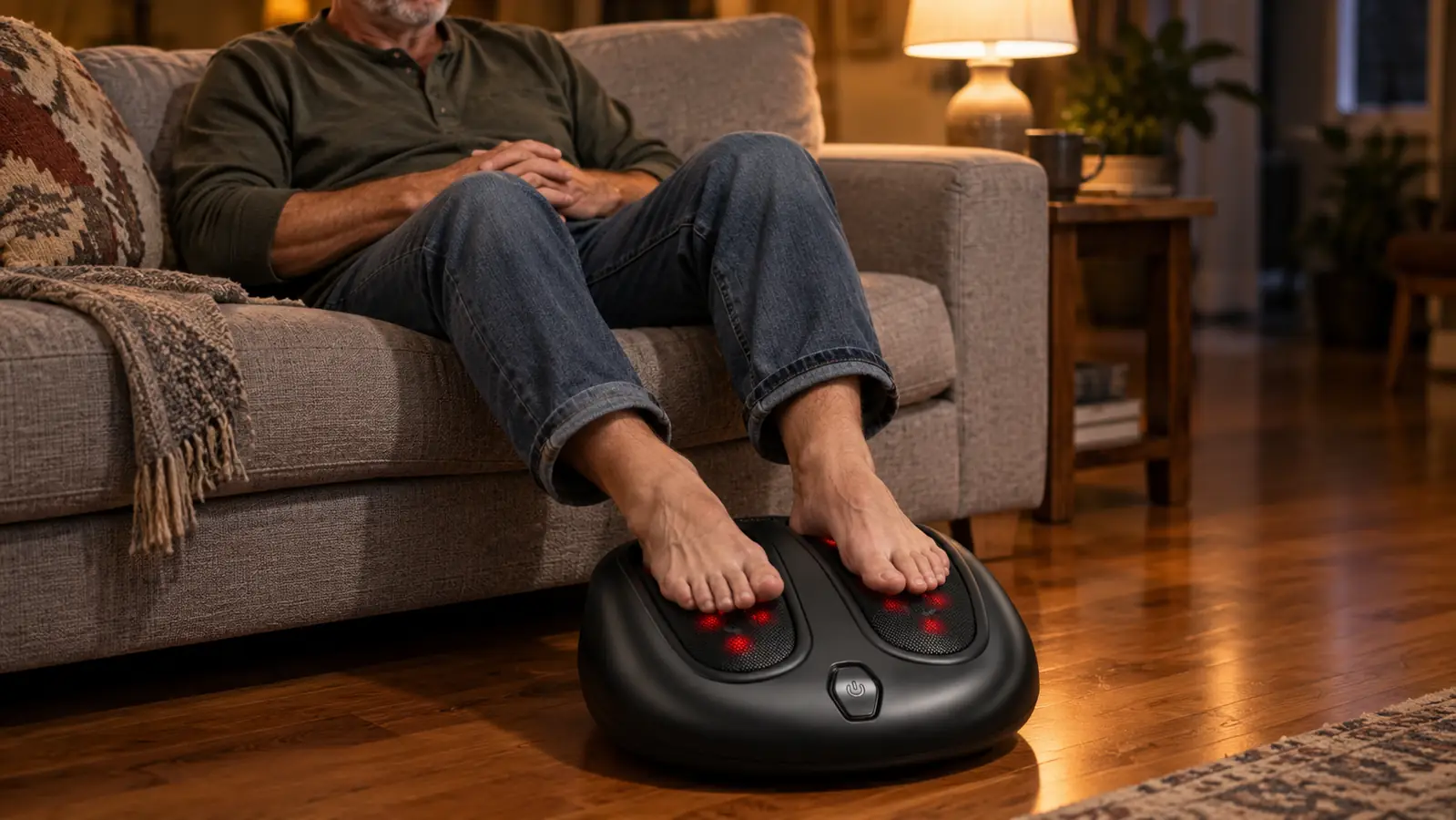
This unit is 15.75 by 14.17 inches and weighs about 6.8 pounds. It is not a gadget you carry from room to room. It is corded, so wherever it lives needs an outlet within reach, and it is built to stay put while you use it. Mine sits on the floor directly in front of my recliner, close enough that I can work it without leaning forward. That closeness is the whole design of the habit.
Write off any plan that involves getting it out of a closet. I have made that mistake with other things and I know exactly how it ends. If it takes two minutes of setup and a hunt for an extension cord, you will use it three times and then it becomes furniture. The whole point is that on the nights your feet hurt the worst, the effort to start has to be close to zero. A machine you have to assemble a plan around is a machine you stop using by February.
One caution from my husband Curtis, who has stubbed a toe on mine twice now: pick a spot out of the walking path. Ours is tucked between the recliner and the side table where nobody cuts through. It is also worth knowing this is not a water resistant unit, so it does not belong in the bathroom and it does not belong anywhere near a wet floor after a shower. Keep it in the room where you sit in the evening and it will get used.
Step 3: Start With Ten Minutes, Heat On, and Stop Before You Want To
There is a power button and a heat button on top, and you can hit either one with your toe. That matters more than it sounds like it should when you are already settled in and the idea of leaning forward is its own small burden. I turn both on and set the kitchen timer for ten minutes. The Nekteck unit has an auto shut-off, so nothing bad happens if I drift off, but I like knowing when the ten is up so I do not lose track and let it run for half an hour.
Ten minutes is the right starting dose. The first week I had it I went twenty-five minutes because it felt good and because I am not a person who does things by halves. My feet were tender the next morning in a way that had nothing to do with my walk. The heat and the kneading together are a real load on soft tissue. More is not better here. More is just more, and your feet have to get up and do it again tomorrow.
It runs quiet enough that I can hear the television over it, which matters if you are the sort of person who wants to watch the news and not think about your feet for a few minutes. Curtis sits across the room with a book and has never once complained about the noise, and he complains about most things that hum. If you have a small living room and thin walls, that quiet is worth more than any feature on the box.
Step 4: Move Your Feet Around Instead of Just Leaving Them There
The six massage heads with 54 rotating nodes work in a fixed pattern. They knead where they knead and they do not go looking for your trouble spots. That means the useful part of the routine is you shifting your feet: heel first for a couple of minutes, then the arch, then the ball of the foot pushed a little further forward. Same ten minutes, three different spots, and it feels like a completely different session than just parking your feet and checking out.
The direction of the kneading can be reversed with the controls. When the pattern starts to feel like the same thing over and over, flipping it is enough to make it feel new again, and honestly that is most of the reason I keep using it instead of getting bored. The first direction is the warm-up. The reverse is the part where the tight spot in my arch finally lets go. If I only had one direction I would probably have quit on the thing by now.
If your feet are a women's 8.5 wide like mine, you will find you can shift around without your foot sliding off the working surface. If you have a considerably longer foot, you may spend more of your ten minutes repositioning than resting, and that is worth knowing before you buy. It is the one thing about this unit I would change if I could, and it is the honest tradeoff at this size.
Step 5: Two Minutes of Your Own Work, Then Get Them Up
When the ten minutes is done I do two things the machine cannot do for me. First, ankle circles, ten in each direction, slow, no bouncing. Second, a calf stretch with the ball of the foot against the base of the recliner, thirty seconds a side. The machine works on the bottom of the foot. Your calf is what has been pulling on your heel all day, and it does not get touched by anything you rest your foot on. Two minutes of stretching is the difference between a good session and a wasted one.
Then the feet go up on a cushion, above heart level if you can manage it, for as long as you can stand. On a bad night that is ten more minutes and Curtis brings me a glass of water. On a good night it is two minutes and I am up making dinner. Either way, ending with the feet elevated is what separates sore-before-bed from sore-tomorrow, and it costs nothing.
I finish with lotion and a pair of clean socks, because a foot that has been warm for ten minutes loses that warmth fast on a tile floor and cold feet at nine o'clock are their own separate problem. Then the Nekteck goes back between the recliner and the side table and I unplug it for the night. The whole routine, start to finish, is about twenty-five minutes, and half of that is just sitting there.
What Else Helps
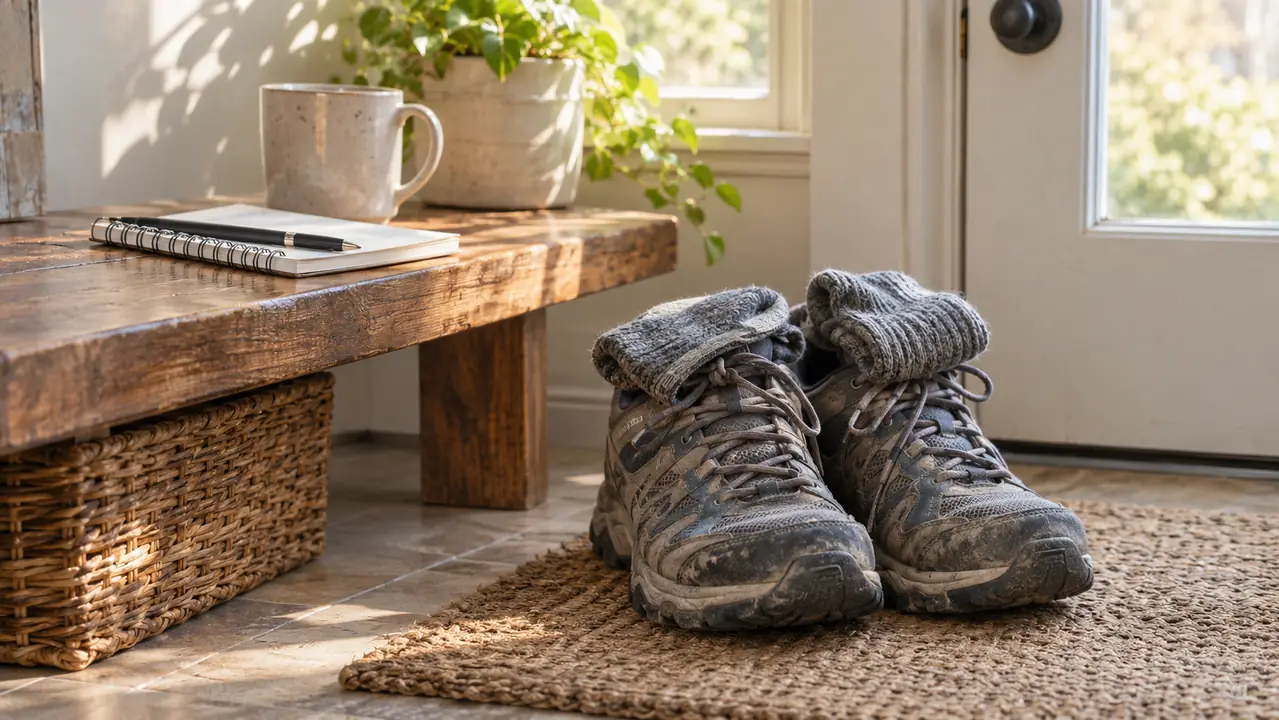
The massager is the last twenty minutes of the day. The rest of it is shoes, and shoes are most of the story. I keep a notebook with the miles logged on each pair and I retire them somewhere between 400 and 500 miles whether they look worn out or not. The pair that got me through last spring looked perfectly fine on the outside and felt like a different shoe entirely by mile 450. Feet notice what eyes do not.
Second thing: get off them at lunch. Not to walk somewhere, just to sit with your feet off the floor for ten minutes. I eat in the back room with my feet on an overturned crate and it has done as much for my evenings as anything I have bought. Third thing: change shoes halfway through the day if you can. Even a cheap second pair gives the cushioning in the first pair a chance to recover, and it changes which part of your foot takes the load.
And the thing I would tell a coworker on break: if the soreness does not fade with a night of sleep, or if the first steps out of bed in the morning are the worst part of your day for more than a couple of weeks running, that is a podiatrist conversation, not a massager conversation. I had a bout of heel pain a couple of years back that got me serious about all of this. What turned it around was somebody looking at my feet properly and better shoes, not a gadget. A massager is comfort. It is not treatment, and no box is going to tell you the difference.
Ten minutes with the heat on and I can walk out to the mailbox without thinking about it. That sounds like a small thing unless your feet hurt every single day.
If your feet are the last thing you think about at night, start here
Six kneading heads, 54 nodes, heat, and a toe-touch button you can reach without sitting up. Ten minutes after your shoes come off. Not a cure for anything, just a better end to a long day.
Amazon Check Today's Price on Amazon →