
I keep a spiral notebook in the kitchen drawer with two columns: the date I start a pair of walking shoes, and the miles I put on them. It sounds fussy until you have spent a month favoring one heel. I am 56, I work part time at a hardware store in Dayton, Ohio, and I walk four to five miles most days. Standing on concrete for a shift and then walking a neighborhood loop will teach you quick what your feet will put up with. The socks I reach for now are CHARMKING compression socks, the 15-20 mmHg ones that come three pairs to a pack.
A couple of years ago I had a stretch of heel pain that made the first ten minutes of every walk feel like a negotiation. I bought better shoes, added an insole, and started paying attention to when my shoes were worn out instead of waiting for a hole. I am not a doctor. I am not going to tell you a pair of socks fixes anything. What I will tell you is that the right sock became part of the routine that got me walking comfortably again, and the wrong sock could ruin a good shoe day.
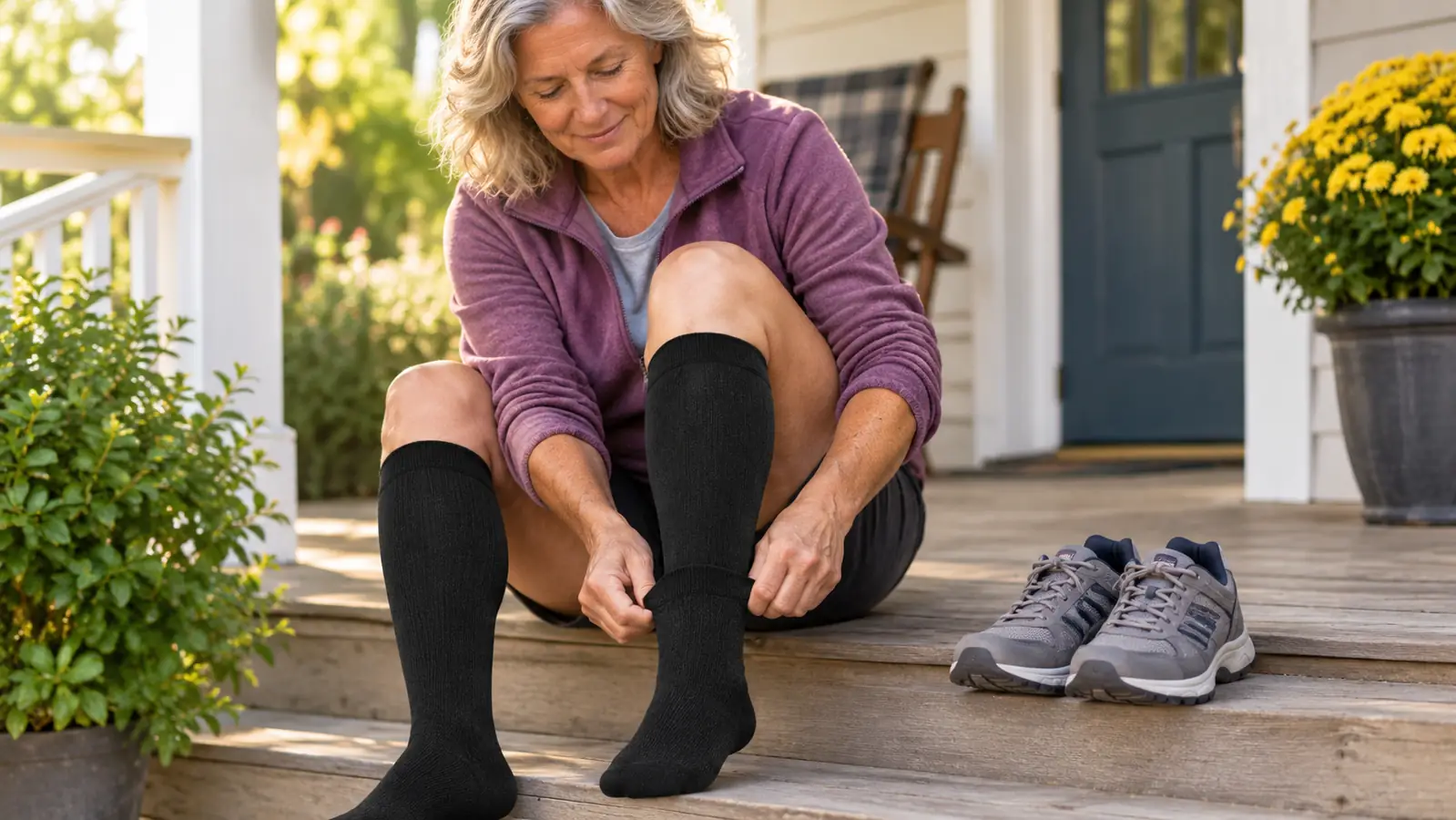
Compression is one of those words that gets used loosely. The CHARMKING pack lists 15-20 mmHg on the label. That is a mild range. It is not the tight, medical-grade stuff a nurse might put on you after surgery. Think of it as a firm hug through the foot and calf, enough that you notice it when you pull it on and forget it by the time you reach the end of the driveway. If you have a circulation condition, nerve damage, or you are being treated for a wound, ask your doctor before you buy any compression sock. That is not a disclaimer I am tacking on. It matters.
The first time I pulled on a pair, I did it the way I do everything, in a hurry, and I got the heel in the wrong spot. You have to work them over the foot and line up the heel before you haul the rest up. Once I slowed down, it took maybe fifteen seconds per leg. The fabric is 85% nylon and 15% spandex, and it feels slick and stretchy in the hand, not like a thick wool sock. They are machine wash, which matters to me because I am not hand washing anything at ten o'clock at night.
I wear the Large-X-Large, and my street shoe is a women's 8.5 wide. The fit is snug through the arch and the calf, which is the point, but it is not so tight that it leaves a deep mark behind my knee. I put them on before my shift, wear them through the concrete floor and the register, then keep them on for my after-work loop. I take them off before bed. That is my routine. It is not a prescription.
The change I noticed was not dramatic. It was that I stopped sitting on the tailgate to rub my arch before the last mile.
The pair that made the last mile less of a project
Three pairs to a pack, 15-20 mmHg, machine wash. I keep one pair in the drawer, one in the laundry, and one in the car for the days I squeeze in a park trail after work.
Amazon See the CHARMKING 3-Pair Pack on Amazon →On a workday, the difference is mostly in how my legs feel by the time I clock out. Concrete is unforgiving. Before I started wearing them, I would get to the end of a shift and feel like I had been standing on the same two spots all day, because I had. The socks do not turn concrete into a rubber mat. They give me a little support, and that is enough for me to finish my loop instead of cutting it short.

On the weekend, Curtis and I walk a park trail that has one long uphill grade. He is faster than me on the way up and I am faster than him on the way down, which we both find funny. The socks have held up through a couple of months of that, plus the laundry. I have not seen a hole or a worn spot at the heel. The color has faded a little, but I expected that. I am more interested in whether the stretch holds, and so far it has.
There are things I do not love. They are tighter than a regular sock, so if you have arthritic hands or a shoulder that complains, getting them on can be a chore. I have a technique now where I bunch them up to the heel and roll them on, but the first few times I fought them. The sizing is limited to what is on the listing, so if you are on the edge between sizes you may have to decide whether you want a firmer fit or an easier pull. And they are not a substitute for shoes that fit. I still replace my walking shoes every 400 to 500 miles, and I write it in the notebook so I do not talk myself into one more month.
I also would not wear them as a cure for anything. If your feet are numb, if you have a wound that is not healing, or if the pain is sharp and persistent, see a podiatrist. A sock is a comfort item. It is not a diagnosis. What I can tell you is that for an everyday walker with slightly flat arches and a job that keeps her on her feet, the CHARMKING socks have earned their spot in the drawer. I bought a second pack so I am not doing laundry at midnight just to have a clean pair for the morning.
What I'd Tell You If We Were Sitting at My Kitchen Table
If you were across from me with a cup of coffee, I would say start with one pack and wear them on a normal day, not a special one. Put them on before you leave the house, not in the car, because you want to get the heel seated right. Wear them for your shift or your walk, take them off when you are done, and wash them with the rest of your laundry. Give it two weeks. If your legs feel better at the end of the day, keep going. If they feel worse, or if you get numbness or a mark that does not fade, stop and call your doctor. And do not skip the shoe part. A good sock in a worn-out shoe is still a worn-out shoe. That is the whole speech. The rest is just walking.
One pack, three pairs, a normal week
Start with the three-pair pack. Wear one, wash one, keep one for the car. If you are on your feet for work and you walk for the rest of it, that is the rotation that actually gets used.
Amazon See the CHARMKING Compression Socks on Amazon →