
Two weeks ago a coworker at the hardware store asked me why I bother pulling on a pair of CHARMKING compression socks before a shift when there is a whole drawer of ordinary walking socks at home. Fair question, and I did not have a tidy answer ready. I am 56, I walk 4 to 5 miles most days, and I spend eight hours standing on concrete selling screws and paint. My feet are a women's 8.5 wide with slightly flat arches, and a bout of heel pain a couple of years back is what got me serious about what goes on them in the first place. So I have had reason to pay attention.
Here is the short version before the long one. Regular walking socks are built to cushion and to breathe. CHARMKING compression socks at 15-20 mmHg are built to squeeze, evenly, from the ankle up. One is a cushion. The other is a hug that keeps working while you stand there. Neither one replaces a decent shoe or a proper insole, and neither one fixes anything. They make a long day more comfortable, which is a smaller claim than the internet usually makes and a truer one.
| CHARMKING Compression Socks | Regular Walking Socks | |
|---|---|---|
| Compression | 15-20 mmHg, printed on the pack | None. Fabric and stretch only. |
| Fabric | 85% nylon, 15% spandex | Usually a cotton blend with some stretch |
| Getting them on | Pull-on, and it takes a minute and a real tug | Slides on like any sock |
| Cushioning underfoot | Thin. You feel the floor through them. | Thicker knit through the heel and ball of the foot on most pairs |
| Sizing | Sold in sized ranges, Large-X-Large among them | Sold by shoe size, roomier through the calf |
| Pairs per pack | 3 pairs | Varies. Often one or two. |
| Care | Machine wash | Machine wash |
| Eight hours on concrete | My ankles are less puffy by five o'clock | Soft at nine in the morning, settled and baggy by mid afternoon |
| Wearing them to bed | Doable, though the squeeze is noticeable | Comfortable |
| Hot weather | Nylon holds warmth. Fine in spring and fall, less so in July. | Breathes better on a humid afternoon |
| Best for | Long shifts and long walks on hard ground | Short errands, lounging, hot days, anybody who hates tight things |
I am not a lab and I am not a nurse. What I have is a notebook where I write down miles per pair and how my feet feel at the end of a shift. Same shoes, same insole, same concrete floor. On work days I have worn the compression pair for the shift and changed into a regular walking sock for the evening. On days off I have walked the five mile park trail both ways, one week in each. That is not a study. It is about as honest a comparison as one woman with two feet and a pen can manage.
One thing worth saying up front. Socks are the cheapest thing in the chain and the last thing anybody thinks about. I spent years buying good shoes and then stuffing whatever was in the drawer inside them. If you can only change one thing, change the shoe. If the shoe is already sorted, the sock is where the next bit of comfort lives.
Where CHARMKING Wins
Standing. That is where these earn their place. Eight hours on a concrete floor and by mid afternoon my ankles used to feel like they belonged to somebody else, and my shoes would be noticeably tighter than they had been at nine in the morning. With the compression pair on, that swelling is smaller. Not gone. Smaller. I notice it most when I untie my shoes at the end of a shift and they come off easily instead of needing a wiggle and a shove.
The clearest test came on a Saturday in March when the store took a pallet delivery and I spent six hours walking the same forty feet between the aisles and the back room, then stood at the register for two more. Same shoes as always, same thin insole. I got home, sat down on the porch step, and my shoes came off without a fight. The week before, in a plain sock, on a shorter day, I had to work the left one loose with my heel. That is the whole comparison in two sentences.
The second thing is how they hold their shape. The label says 85% nylon and 15% spandex, and it behaves like it. A plain cotton sock goes soft around the ankle after a few hours and starts working its way down into the shoe. These stay where you put them. I have three pairs in rotation and they have been through the machine more times than I can count without going slack at the top.
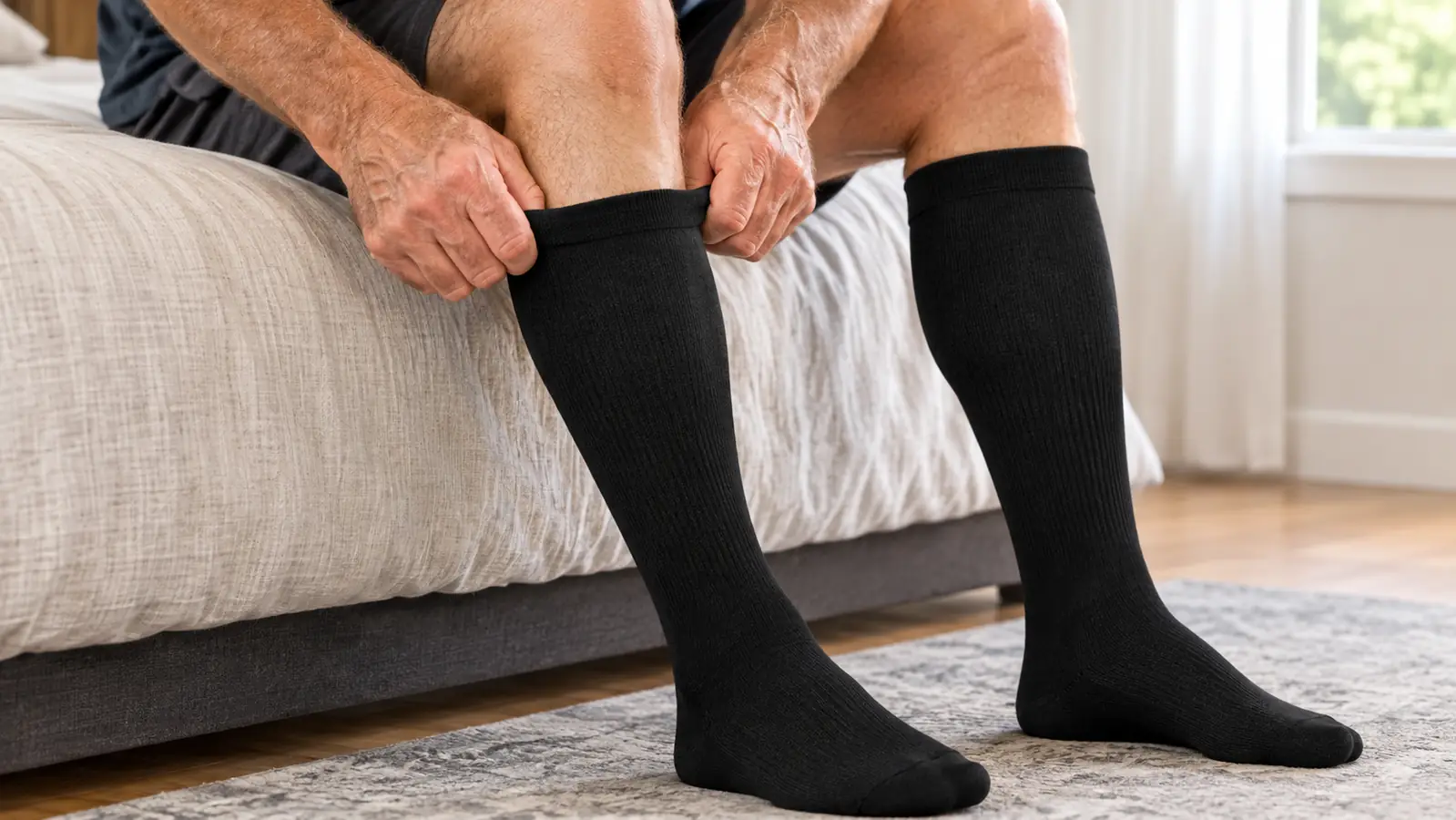
Then there is the small business of putting them on, which sounds like nothing on paper. There is no zip, no strap, nothing to fasten. The closure is pull-on and that is the entire procedure. On a morning when I am already late for a shift, that matters more than I expected it to. It also means there is nothing digging into the ankle by the eighth hour.
The last thing, and this one surprised me. I stop thinking about my feet. On a plain sock day I notice my feet at two in the afternoon. On a compression day I notice them at ten at night when I take the socks off. That is not a scientific measure. It is a real one.
Where Regular Walking Socks Wins
Cushioning. I will not pretend otherwise. A decent walking sock has a soft, thicker knit through the heel and the ball of the foot, and you can feel the difference on gravel. The compression pair is thin underfoot. On a long park trail with roots and small stones, I want that cushion, and I want it in a plain sock.
Ease. A compression sock takes a minute and a real tug. If your hands ache, or your hip does not want to bend that far first thing in the morning, a plain sock is simply easier, and that is not a small thing in January when the house is cold and the shift starts at seven.
Heat is the other one. Nylon holds warmth. On a humid Ohio afternoon in July, a thin cotton sock is the more comfortable choice by a wide margin, and I switch to plain socks for those weeks without feeling guilty about it. I wear plain socks to bed as well. The squeeze is not unpleasant, but it is noticeable, and I want to sleep.
On the park trail on a Sunday in April I wore the plain socks for the five mile loop and was glad of it. There is a stretch past the second footbridge where the roots come up through the dirt, and a run of loose gravel after that. In a thin sock I feel every one of them through the sole, and by mile four my heels are letting me know. In the plain sock I finished the loop and forgot about my feet entirely until I sat down in the car.
And plain socks are quiet. Nobody looks twice at an ordinary walking sock. The compression pair is snug enough that you can see it under a trouser leg if you look, and I have had exactly one person ask me about it in six months, so it is hardly a conversation piece. But it is not invisible either.
Eight hours on concrete. By five o'clock my shoes come off without a wiggle instead of needing a shove. That is the difference I can actually measure.
How Three Pairs Actually Plays Out
Three pairs is the right number and I did not expect to care about it. One on, one in the wash, one dry, and the rotation never gets ahead of you. If it were a single pair I would be rinsing them in the sink at ten at night and hanging them over the shower rail, and I would have given up on the whole thing inside a month.
I do laundry on Wednesdays and Sundays, which gives the rotation a rhythm. Wednesday night two pairs go in the machine and one stays out for Thursday. By Sunday I am back to three clean. What I did not expect was how much I would come to lean on that rhythm. The one morning I was down to a single dry pair, I stood in the kitchen at six deciding between a damp sock and a plain one, chose the plain one, and felt the difference in my ankles by noon.
They are machine wash, which is the only care instruction I have ever managed to follow. I put them in with the rest of the laundry and I do not put them in the dryer. That last part is not on the label, it is from me, because elastic and a hot dryer are not friends. Months in, all three pairs are still doing their job and none of them have gone baggy.
A note on the fabric while I am here. Nylon and spandex do not breathe like cotton and they do not pretend to. What they do is hold tension. That trade is the whole product in one sentence. You give up a little breathability and a little softness, and you get a sock that still fits like a sock at five in the afternoon.

What Week One Feels Like
The first week is an adjustment. They feel tight when you first pull them on, tight enough that I checked the sizing twice before I wore them out of the house. Twenty minutes in, the feeling settles and stops being something you notice. By the end of the first shift my legs were tired in the ordinary way rather than the heavy way, and that was the whole result I was hoping for.
By the end of that first week I had worked out the trick to getting them on. Gather the whole leg of the sock down to the heel first, get your foot in, then roll it up rather than yanking at the top. Yanking is what turns it into a fight. Rolling takes about thirty seconds and saves your thumbs. I wish somebody had told me that on day one instead of day five, because the first four mornings I made it harder than it needed to be.
A word on size, because this is where people get it wrong. These come in sized ranges rather than by shoe size, and Large-X-Large is the one I take at a women's 8.5 wide. If you are between ranges, or your calf has always been hard to fit, measure before you order instead of guessing. There is nothing worse than a compression sock that is a fight to get on and a fight to get off.
How I Decide Which Pair Goes On
Work day: the compression pair. Day off with a long trail: plain walking socks, and then the compression pair for an hour afterwards while I have my coffee. Hot July afternoon: plain. A two hour drive to see my sister in Columbus: compression, because sitting still in a car does the same thing to my ankles that a shift does, only slower.
Curtis and I walked the park loop on a Sunday in May and I wore plain socks for the walking and pulled the compression pair on the minute we got back to the car. Twenty minutes later my ankles had stopped buzzing. He asked whether I was going to wear them to the grocery store too. I said no. That is about the size of it.
That is the honest answer. It is not one or the other. It is which part of the day you are in and what you are asking your feet to do. Anybody telling you to throw out every ordinary sock in the house is selling something.
What I Liked
- Holds its shape through months of machine washing
- Noticeably less swelling by the end of a shift on concrete
- Three pairs means one on, one washing, one dry
- Nothing to fasten, you just pull them on
- 15-20 mmHg is light enough to wear for a full shift
Where It Falls Short
- Thin underfoot, so you feel gravel and tree roots
- Takes a minute and a real tug to get on
- Warm in humid weather
- Not a replacement for cushioning on long trail walks
If your ankles are puffy by five o'clock, start here
Three pairs, 15-20 mmHg, machine wash. That is the whole offer. Wear them for one week of shifts and see whether your shoes come off easier at the end of the day.
Amazon Check Today's Price on Amazon →Who Should Buy Which
Buy the CHARMKING compression socks if you stand or sit still for long stretches and your feet and ankles feel tight and puffy by the end of it. A store floor, a hospital ward, a school kitchen, a till, a truck cab, a desk. If you are covering 4 or 5 miles a day and the shoes are already sorted, this is the next thing worth trying. For reference, I landed in the Large-X-Large range, and it is snug without being a fight.
Stay with regular walking socks if you want cushioning above all, if you cannot stand anything tight around the calf, or if you are only out for twenty minutes a day on grass. And if your feet hurt in a way that does not settle after a night of rest, socks are not the answer. That goes to a podiatrist. I say that as somebody who put off a heel problem for four months and regretted every one of them.
One drawer, two jobs
Keep the soft socks for the trail and the hot days. Put the CHARMKING pair on for the shift that pays for them. Three pairs, machine wash, and one week to find out whether it makes a difference for you.
Amazon See the CHARMKING Compression Socks on Amazon →