The first morning I pulled on a pair of CHARMKING compression socks I nearly gave up on them before I got out the door. Not because they hurt. Because I had never worn a 15-20 mmHg sock before, and I did not know that getting one on is a small physical skill you have to learn. Nobody mentions that part. Everyone talks about how your legs feel at the end of the day. Nobody tells you about standing in your bedroom at 5:40 in the morning, thumbs hooked into the cuff, wondering whether you are doing it wrong.
Here is where I am coming from. I am 56, I work part time at a hardware store in Dayton, Ohio, and I walk four to five miles most days, a loop around the neighborhood before my shift and a longer park trail on my days off. I have wide feet, women's 8.5 wide, slightly flat arches, and a bout of heel pain a couple of years back that made me take shoes, socks and recovery seriously for the first time in my life. I wore the CHARMKING three pack through a full season, on concrete at work, on the sidewalk loop and on the park trail. This is the honest version, including the parts that are a nuisance.
The Quick Verdict
Three pairs of genuinely wearable 15-20 mmHg compression that held up through long shifts on concrete, provided you measure before you order and you are patient with the on and off. They are thin, so there is no cushioning, and the cuff softens over a season.
Amazon Check Today's Price →Three Pairs Is the Reason These Get Worn Instead of Sitting in a Drawer
15-20 mmHg, three pairs to a pack, machine wash, pull-on closure. Measure your calf and your ankle with a soft tape before you order, because the listing chart decides more than this review can.
Amazon Check Today's Price on Amazon →How I've Used Them
I wore them the way I wear everything, which is to say without a plan. One pair went into the work rotation under jeans on the days I am on my feet on concrete from open until mid afternoon. One pair stayed with my walking clothes for the neighborhood loop. The third lived in the laundry basket and rotated in. I did not follow a schedule and I did not keep a chart. I just wore them and paid attention to how my legs felt at seven in the evening, which is the hour when a long day either shows up or it does not.
The first pair went to work on a Tuesday, which I remember because Tuesdays are delivery days at the store and I am on my feet from seven until two, unloading, stacking and walking the aisles. Concrete, steel shelving, no mat anywhere. I had worn them around the house twice by then and thought I had the hang of it. I did not. By nine I had a rolled edge digging in behind my knee and I ducked into the back room to work the cuff flat with my thumbs, which is the one adjustment I still make most mornings. After that the day went quiet. I drove home at two and did not have the usual ache in my calves by the time I got there, which is the plainest evidence I can offer.
Context on my feet matters here, because fit is most of this product. Women's 8.5 wide, slightly flat arches, a heel that flared up a couple of years ago and made me rethink every shoe and sock in the closet. I keep a notebook with the miles on each pair of shoes and I replace them somewhere around 400 to 500 miles. Socks do not get a mileage log, but these got a fair test across a full season of real walking and real shifts.
The pair I tested is the Large-X-Large, and the listing describes them as a medical compression garment at 15-20 mmHg. I am not a medical person and I am not going to pretend otherwise. I wear them for comfort on long days. That is the entire claim I am making, and it is worth saying plainly at the top because this is where compression sock write ups tend to drift into promises they cannot keep.
What Nobody Tells You About the Size Chart
Sizing is where a compression sock review should start and almost none of them do. This is not a sock you can buy loose and get away with. Too small and you will fight it every morning and quietly stop wearing it by week two. Too big and it slides down the calf and the compression does nothing worth having.
On my foot, the Large-X-Large ran a little long in the foot section. Not enough to bunch under my arch, but enough that I noticed it the first few days, especially in a thinner everyday shoe. In a wider walking shoe with a roomier front it disappeared entirely and I forgot about it. The cuff, which is the part that actually has to stay put, sat where it was supposed to and stayed there through a whole shift.
So the boring advice is also the most useful advice I can give you. Measure your calf at the widest point and your ankle at the narrowest point, with a soft tape, before you order anything. The CHARMKING listing carries its own chart and that chart does more work than this page does. I would rather you read it twice and get the fit right than read my notes and guess.
What 15-20 mmHg Feels Like on a Four Mile Walk
The first ten minutes are strange. There is a firmness around the ankle and the calf that your brain reads as tight, and it spends a while deciding whether it approves. Then you stop noticing it. For me that happened somewhere in the first mile, on the flat stretch of the loop before the hill, and after that they were just socks.
What I noticed on the back half of a walk was the absence of something. By mile three my calves usually carry a heaviness and my ankles feel puffy by the time I hit the driveway. With these on, that heaviness arrived later and softer, and on the days I was on concrete at work the difference was easier to feel than it was to describe. That is the reason I kept reaching for them, and it is not a dramatic reason. It is a practical one.
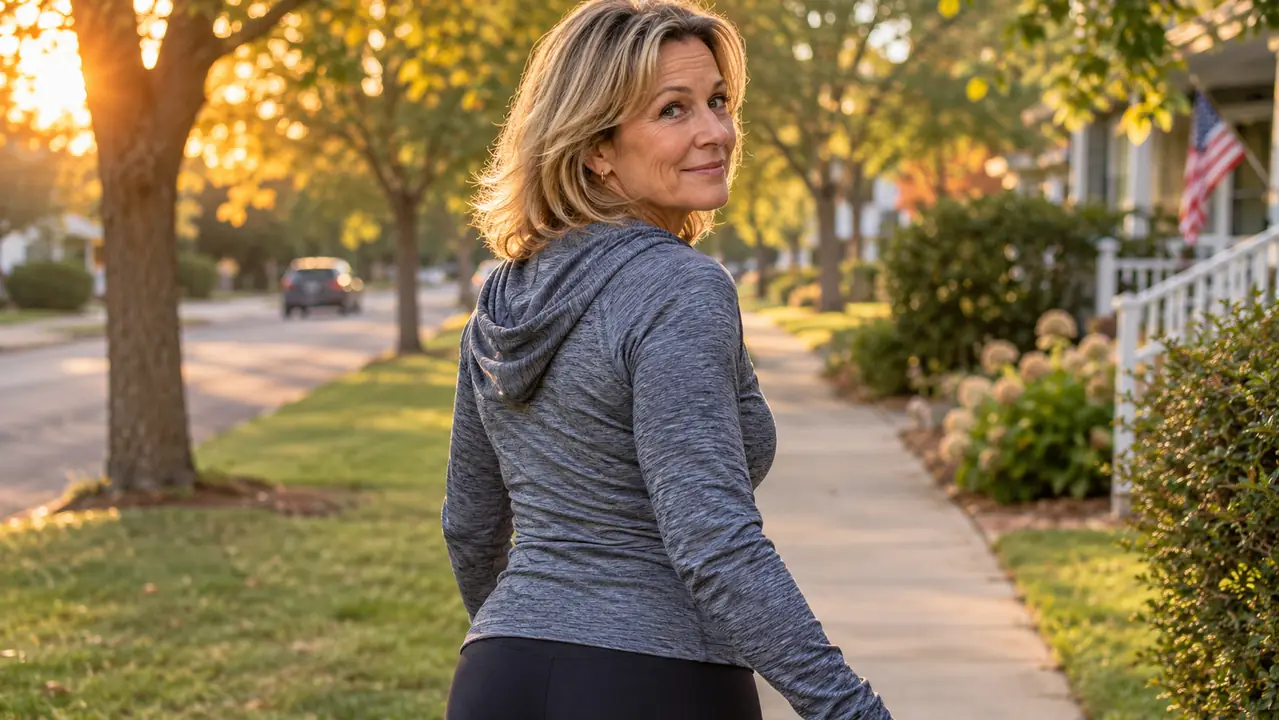
There is a specific stretch of the park trail where I finally noticed it clearly, a long steady climb that comes about two and a half miles in and has always been the place my legs start talking to me. On a Saturday in October I walked it with my husband Curtis, both of us in walking clothes and arguing about whether that trail needs another rest bench, and I got to the top and realized I had been talking the whole way up. That is not something a lab can measure. On the flat loop it is harder to tell the difference. On that hill it was not.
I want to be careful here, because this is exactly the point where compression sock copy goes off the rails. These are not a treatment. They do not cure anything and they did not undo my heel history. They make a long day on your feet feel less punishing, which is a modest thing and, for me, worth having. If your feet hurt in a way that has lasted more than a couple of weeks, do not buy socks. Go see a podiatrist. I say that as someone who waited too long before getting her own heel looked at.
The Getting Them On Problem
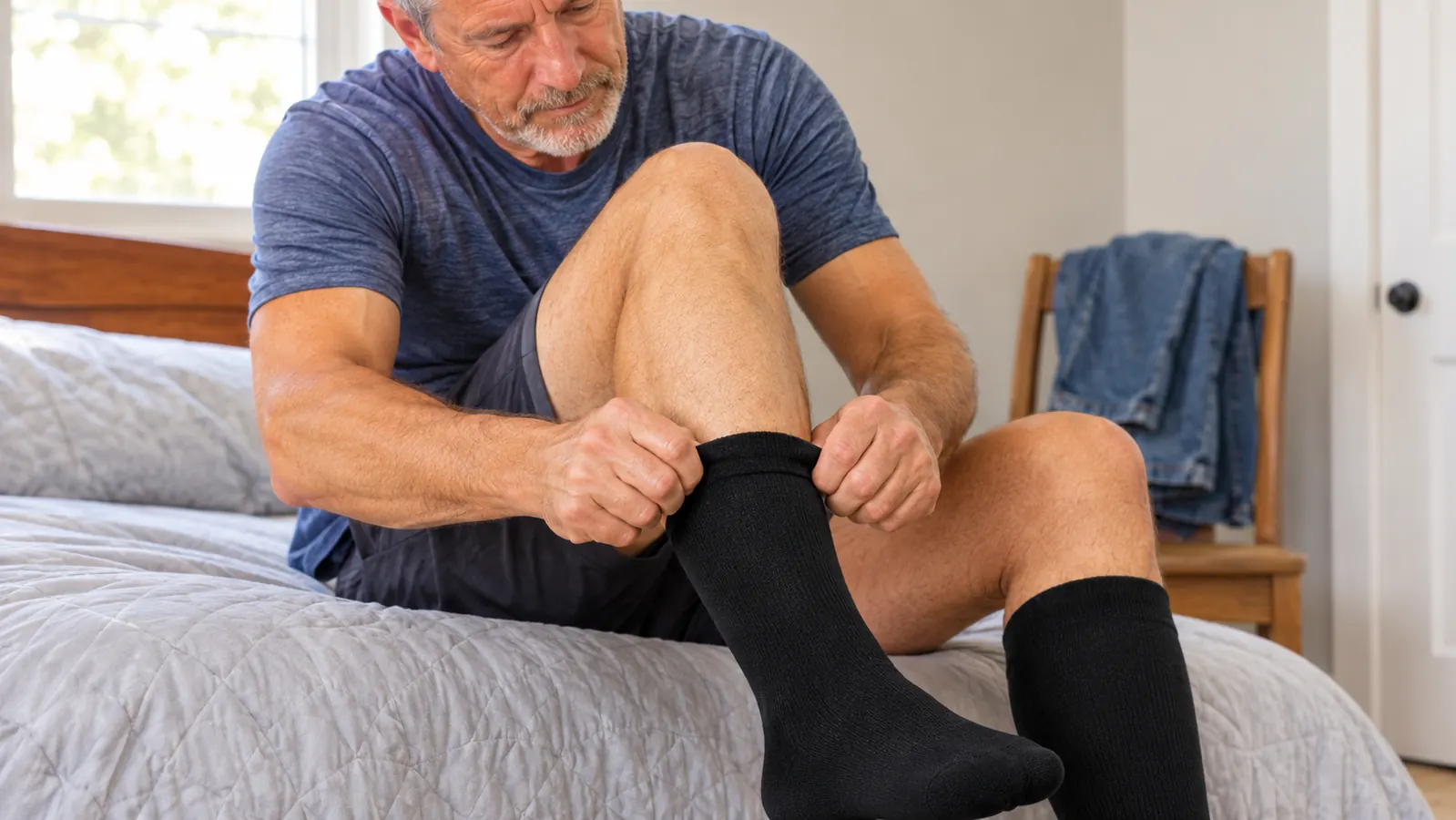
The listing calls the closure pull-on, which is accurate and also undersells it. There is no zip, no strap, nothing to loosen. It is you, a sock and your thumbs, and the first few mornings are a genuine wrestling match.
The method that finally worked took me about a week to find. Put your hand all the way into the sock, grab the heel from the inside, and roll the whole thing down to the front before your foot goes anywhere near it. Then work it up in stages, foot first, then over the heel, and never in one long pull. Your thumbnail will thank you. Once the heel is seated, bring the cuff up last and smooth it flat so there is no rolled edge pressing anywhere.
Taking them off at night is its own small chore. You hook a thumb into the cuff and peel, and it takes both hands and a little patience. It is not a reason to skip them, and by week three I could get a pair on in under a minute. But it is the sort of thing you should know before you buy, because a sock you dread putting on is a sock that stays in the drawer.
Three Pairs, and Why That Matters More Than It Sounds
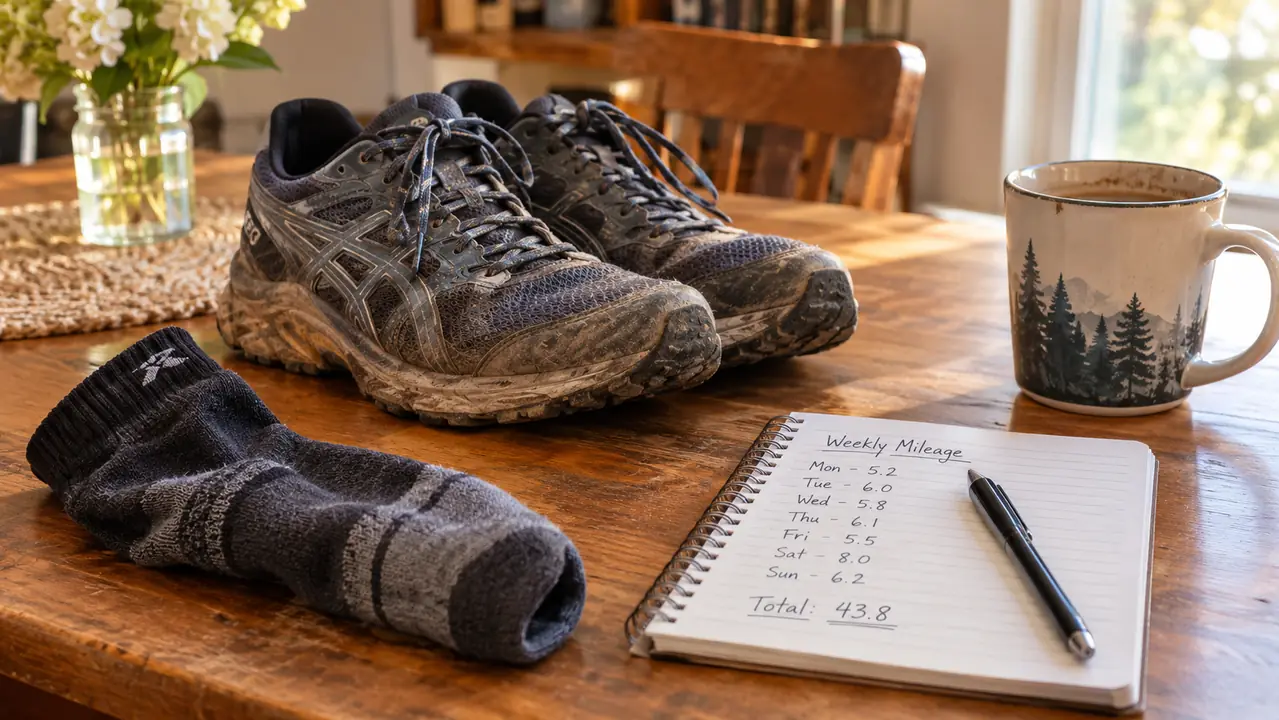
The three pack is the part of this product I would defend hardest, and it has nothing to do with the fabric. Compression socks get washed between wears like any other sock. If you own one pair, you own a pair that spends half its life in the laundry and the other half being resented for being in the laundry.
Three pairs means one on your legs, one clean in the drawer, one in the wash. That is the whole system and it is enough. It is also why I never once had a morning where I wanted them and could not find them, which is the actual failure mode with this kind of thing. People do not quit compression socks because the socks failed. They quit because the sock was wet.
The wash routine settles into itself fast. I run them cold on a Sunday with the rest of the week's socks and undershirts, then hang them over the rail on the dryer with a clip at each cuff instead of putting them in the drum, and they are dry by evening. The care instructions say machine wash and nothing more specific, so I am telling you my method, not the manufacturer's. Cold water and air drying is what has kept mine in one piece, and it costs me about four minutes of a Sunday morning.
The three pairs together weigh about 6.4 ounces, which tells you how thin they are. Thin is what you want under jeans at work, and it is also the honest limit of the product. There is no padding in these. If you want cushion under the ball of your foot, that has to come from your shoe or your insole, not from the sock. I also put them up against my plain walking socks to see whether the difference was real, and for me it shows up right around the third mile.
Where They Come Up Short
The tops relaxed over a season of washing. The care instructions say machine wash, and I machine washed them cold and hung them to dry, and they still softened at the cuff by the end of the test. They never fell down. They just stopped feeling quite as firm at the top as they did in week one, and I noticed it most on the longest days.
I want to date that fairly rather than wave at it. I started wearing them in late August and the cuffs felt noticeably softer by the middle of November, which is about twelve weeks and somewhere near fifty wash cycles spread across the three pairs. They also picked up a faint fuzz along the outer calf where my jeans rub, which nobody will see and I noticed anyway. Nothing structural. No holes, no runs, no seam letting go. If you want a number, I would call these a twelve month sock rather than a three year sock, and I would plan on a second pack instead of waiting for the elastic to tell me.
The foot length ran long for me, as I said. In the Large-X-Large, on a size 8.5 wide foot, there is slack at the front. A smaller foot would find that more irritating than I did, and if you sit at the bottom of the size range for that L-XL band you should treat the chart as the deciding document rather than the label.
And they are not a shoe, an insole, or a replacement for either. I still replace walking shoes around 400 to 500 miles. I still stretch my calves against the porch step after a long day. I still sit down and take my shoes off the minute I get home, because that habit is older than any product I own. The socks are one piece of a routine. They are not the routine.
What I Liked
- Three pairs means the laundry never takes them out of rotation
- The 15-20 mmHg feel held up through a full shift on concrete
- The cuff stays where you put it and does not roll down the calf
- Machine wash, cold, hang to dry, no special handling
- 85% nylon and 15% spandex is thin enough to wear under work jeans without a fight
Where It Falls Short
- Getting them on takes a week of practice and real thumb strength
- The Large-X-Large foot section runs long on a wide size 8.5 foot
- The cuff softens after a season of machine washing
- No padding at all, so they are no substitute for a decent insole
- Taking them off at night is a two handed job every single time
Three pairs is not a sales tactic. It is the reason these actually get worn, because the pair in the wash is never the pair you need at 5:40 in the morning.
Who This Is For
If you are in your forties or past it, you stand or walk for a living, and your legs are tired at the end of the day rather than painful, these are worth a try. Nurses, warehouse staff, retail, food service, anyone on concrete for six hours. Also anyone walking a few miles a day who has started to notice that the last mile costs more than it used to. Wide feet are fine here as long as you read the chart. The CHARMKING three pack is a reasonable first pair of compression socks for someone who has never worn any, because three pairs gives you room to learn the routine without running out.
Who Should Skip It
Skip these if you want cushioning, because there is none and that is not a defect, it is what a thin sock is. Skip them if you have a circulation condition, a wound, or a diagnosis you are trying to manage, and ask your doctor first, since the listing itself places these in the medical compression garment category. Skip them if you will not do the two handed wrestling match every morning, because a sock you do not wear does nothing at all. And if you are at the very bottom or the very top of the size table, be honest with the tape measure rather than optimistic.
Get the Size Right and the Rest of It Takes Care of Itself
Three pairs, 15-20 mmHg, machine wash, pull-on. Measure your calf and ankle first, then give yourself a week to learn the on and off before you decide anything.
Amazon Check Today's Price on Amazon →