
My arches have never been much to look at. I am 56, I wear an 8.5 wide, and mine sit a little on the flat side. Two years ago I had a stretch of heel pain that got me serious about what goes on my feet, and I have been fussy ever since. So when a coworker at the hardware store handed me a pair of Copper Compression arch support sleeves and said they got her through a school year on her feet, I did not expect much. I have tried enough things that promise to help with sore arches to be a skeptic before I am anything else.
I wore the Copper Compression arch sleeve for about six weeks. Neighborhood loop before my shift, longer park trail on days off, and eight hours standing on concrete at the register in between. Here is the honest version, including the parts that bugged me.
The Quick Verdict
A slim compression band that gives you arch and midfoot support without changing your shoes. Great for long standing days and short walks. Not a replacement for an insole if you need real cushioning under the whole foot.
Amazon Check Today's Price →Want the same slim band I wore for six weeks?
One size, one pair, and they slip into sneakers, work shoes or boots without changing how anything fits. That is the whole reason I kept reaching for them.
Amazon Check Today's Price on Amazon →How I've Used It
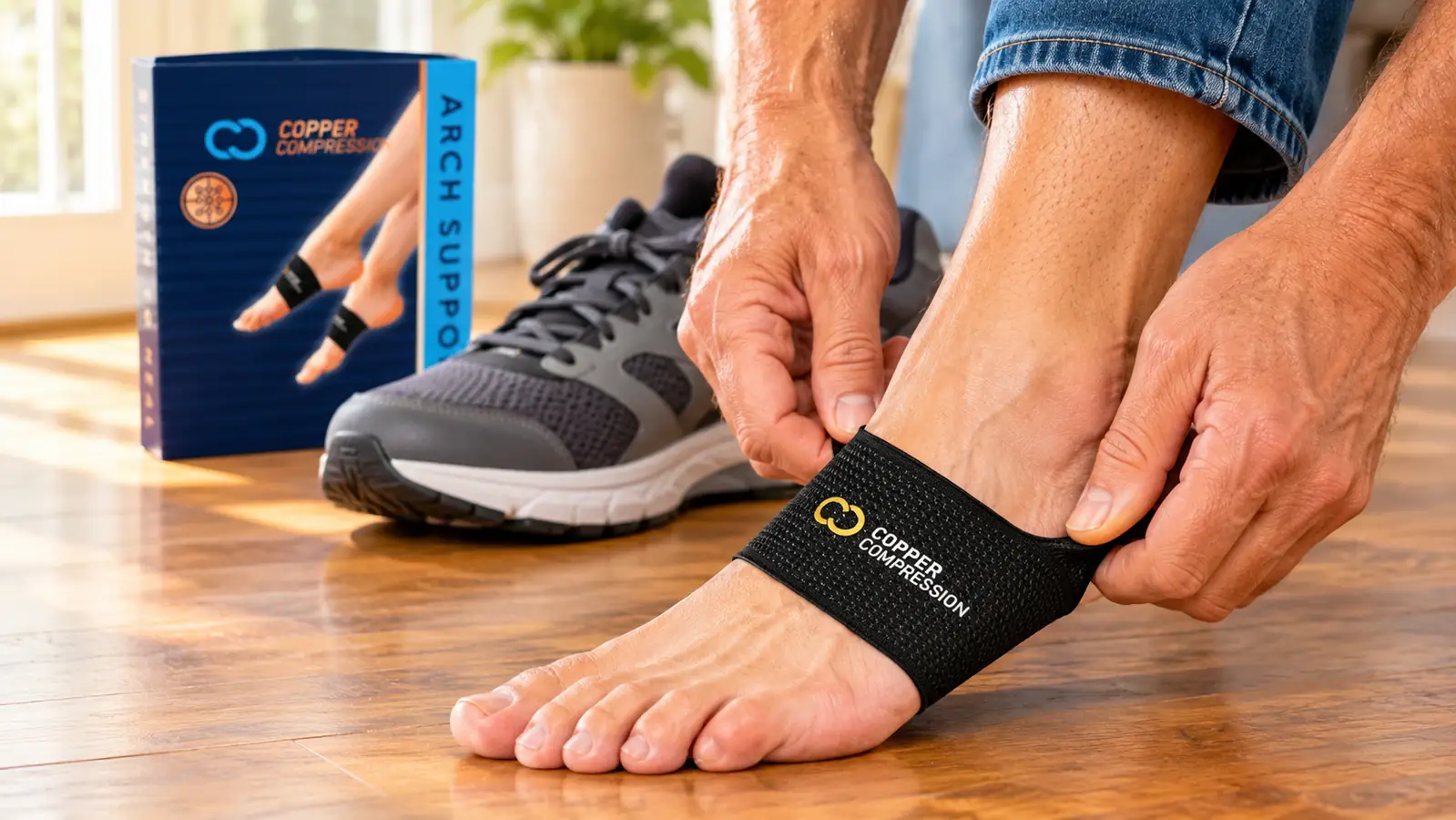
Before I get into anything else, let me be clear about what this thing is, because I think people buy it expecting the wrong item. It is a sleeve, not an insole. There is no foam pad under your heel, no plastic shank, no rigid shell. It is a slim band of stretchy polyester blend fabric that wraps around your midfoot and hugs the arch. The support comes from compression, not from something hard pushing up against your foot.
That distinction matters, and it is why I was skeptical. I have a pair of insoles I keep in my walking shoes and I like them. When the heel pain was at its worst a couple of years back, what helped was cushioning and a slow build back to normal mileage. A fabric sleeve does not cushion anything. So I went in thinking this would be a nice extra and nothing more.
I had already been down this road twice before. First I tried a pair of drugstore arch supports that were so bulky they lifted my heel half out of the shoe and made the whole thing fit like somebody else's boot. Then I tried a compression sock, which squeezed my entire foot instead of just the arch, and by two in the afternoon my toes felt pinched. Both of those I gave up on inside a week. That is the history I brought to a fabric band, and it is why the low profile mattered more to me than any claim on the package.
What I did: first week, I wore them on the short neighborhood loop only, about 2 miles, under a thin sock, in my regular walking shoes. Then I added them to my work shifts, which is the real test. Concrete floors, eight hours, standing and walking the aisles, and a lot of little trips to the back room.
I keep a notebook where I log miles per pair of shoes and retire shoes somewhere around 400 to 500 miles. I mention that so you know I am not guessing at this. I wore the same shoes with and without the sleeve and compared. And I washed them, because a thing you wear on your bare foot for eight hours is going to need washing.
What the Sleeve Actually Does
The whole idea is compression on the midfoot. You pull it on like a sock that only covers the middle of your foot, and it stays put because the fabric grips. In the product listing, Copper Compression calls it gentle compression that hugs your arch so you feel support without changing your shoes. That matches what I felt.
The first thing I noticed was not cushioning. It was a firm, even pressure across the top of my foot and around the arch. Some people will find that immediately reassuring, like a hand holding the arch up. Some people will find it annoying for the first hour. I was in the second group and then flipped to the first around day three.
Let me give you one day in particular, because a single shift tells you more than a month of vague impressions. Second Tuesday of the six weeks, a delivery came in late and I spent close to three hours hauling boxes from the back room out to the floor, then stayed on the register until close. On that day I noticed the sleeve least, which is the point. Around seven in the evening I caught myself standing square instead of shifting my weight from one foot to the other, and that weight shift is my tell when my arches are complaining. Nothing dramatic about it. Just an absence of the usual fidget.
The second thing I noticed was that my foot felt less tired at the end of a shift. Not fresh. Less tired. That sounds like a small thing until you have done a winter of concrete floors. On days I wore the sleeve under my work shoes, I was not doing that thing where you roll your foot on a frozen water bottle at 9 PM.
It fits in almost any shoe, per the listing, and I found that true. Sneakers, my work shoes, and a pair of boots I wear when it rains. Under socks is how I wore them most, though the listing says over socks works too, and I did try that once around the house. Over a sock made it a little too bulky in my shoe for my taste, but I have wide feet and a snug shoe, so your mileage will differ.
Fit, Sizing and the One Size Problem
Here is my main complaint, and it is not a small one: one size. The listing says one size, one pair, and that is what you get. I am an 8.5 wide. My husband Curtis is a 10.5. We both tried them, and while they stretched onto both our feet, they fit very differently. On me there was a little extra fabric bunching at the top of the foot. On him it was snug, which he liked, but he was clear it would not work over a thick sock.
That is just what happens with a stretchy band. The compression is a fixed amount of squeeze and it lands differently depending on your foot size and how much flesh it has to compress. It is not adjustable. There is no strap, no Velcro, no way to dial it in. You get what the fabric gives you.
For me, they fit but did not feel custom. For a wide-footed person with high arches, the stretch does more work and the compression feels lighter. Both high and low arch types are listed as the intended range, which is honest, but it also means the sleeve is doing a compromise job for everyone.
If you have a very narrow foot or a very wide one, borrow a pair before you buy if you can. If you cannot, know that you are getting a general fit rather than a precise one.
Six Weeks of Wear: What Held Up
I want to be specific here because durability is where a lot of cheap foot gear falls apart. These are 1.12 ounces each, roughly the weight of a couple of AA batteries, and they are 6 by 4 by 0.5 inches when laid flat. Thin. That thinness is the whole selling point, and it is also what makes them fragile.
I marked the start date in my notebook and counted wear days from there. Six weeks came to 26 shifts of eight hours, 18 short loops of about 2 miles, and 7 longer trail days where I mostly left them in the bag. That works out to somewhere near 150 hours in the sleeve, which is more than enough time for a fabric band to show you what it is made of one way or the other.
Weeks one and two: no visible change. Elasticity was the same out of the wash as it was new. Week four: the fabric on the bottom of the arch, the part that takes the pressure, started to look a little fuzzy, the way a well-loved pair of socks does. Not thin, not see-through, just fuzzed. Week six: still wearable, still held its shape, but the compression felt slightly softer than it did at the start.
I washed them by hand in cool water and hung them to dry. I did not put them in the dryer and I would not. Heat and elasticity do not get along, and this is a polyester blend holding its grip by stretch alone.
One more wear note: they shift. Not a lot, but on a 5 mile walk I had to reach down and pull one back into place twice. On work days standing at the register, hardly at all, because I was not moving as much. So the longer and sweatier the walk, the more adjusting you do.

Where It Fell Short
The honest limits, in order of how much they bothered me.
No cushioning. Zero. If your heel hurts when it hits the ground, a fabric band is not going to fix that. It supports and compresses, and that is it. On my longer park trail days I still wanted my insoles in the shoe, and I did not wear the sleeve on those days.
The seam. There is a seam on the underside, and in a snug shoe I could feel it against the bottom of my arch for the first mile of every walk. It softened with washing, but I never forgot it was there.
Bunching in tight shoes. In my roomier walking shoes, no problem. In a snug pair, the extra fabric gathers at the top of the foot and you can feel it across the instep. That is the tradeoff for one size fitting everyone.
One small thing worth mentioning, since I was watching for it. After a full shift the band leaves a faint dent around my midfoot, the same kind a sock cuff leaves, and it fades in about twenty minutes. I only noticed because I was paying attention for this review. I also fell into a rhythm of hand washing them every three shifts, which meant a night without them every few days. Two pairs would honestly suit me better than one for that reason alone.
And the big one: this is a comfort product. It is not a treatment. It did not make my arches different and it will not make yours different either. If your foot pain is persistent, meaning weeks not days, and it is getting worse, that is a podiatrist conversation, not a purchase. I say that as somebody who put off that conversation for a year and regretted it.
What I Liked
- Slim enough to wear under socks in almost any shoe, sneakers, work shoes, or boots
- Gentle compression across the midfoot that helped me feel less foot-tired after a shift
- One pair covers both feet and weighs almost nothing, easy to keep in a work bag
- Held its shape through six weeks of daily wear and hand washing
- No rigid parts, so it does not change how your shoe fits the way an insole does
Where It Falls Short
- One size only, so the fit is a compromise and the compression lands differently on different feet
- No cushioning at all, so it will not help a painful heel strike
- Fabric shifts on longer walks and needs pulling back into place
- A seam under the arch that you can feel in a snug shoe
- Compression softens gradually with washing and wear, so plan on replacing them
Who This Is For
If you stand on hard floors all day and your feet ache by the end of a shift, this is worth trying. Nurses, teachers, retail, warehouse, anybody who is on their feet and does not want to rebuild their shoe rotation around it. It is also a reasonable option if you want a small amount of arch support for shorter walks, or if your shoes are already comfortable and you do not want to disturb the fit with an insole.
It suits the person with mildly flat arches like mine, or someone who wants gentle pressure through the midfoot during the day and does not need anything rigid. Both high and low arch types are listed, and I think that is fair, with the caveat that the fit will feel different across that range.
It also suits a person who wants to test the idea of arch support without spending on custom orthotics. It is a low-commitment way to find out whether compression at the midfoot is something your feet respond to at all.
Who Should Skip It
Skip it if your main problem is impact. Heel pain that spikes when your foot lands, or a need for cushioning under the whole foot, is not what this solves. Get a proper insole or a shoe with more foam under it.
Skip it if you have a very wide or very narrow foot and you need something that actually fits you. One size is one size. Skip it too if you have circulation problems or numbness in your feet and have not talked to a doctor about compression, because that is a question for a professional, not a product listing.
And skip it if you are looking for a cure. It is a sleeve. It helps with comfort while you wear it. If your foot pain is persistent, weeks of it, and it is not settling, go see a podiatrist. That is the advice I would give a coworker on break, and it is the advice I give you.
I still keep mine in my work bag. I wear them on shift days and on the short loop, not on long trail days where I want the insoles. Six weeks in, that is the honest split, and it has been worth having them.
If a long shift on concrete leaves your arches aching, start here
One pair, one size, thin enough to wear under socks in the shoes you already own. Put them on for a shift and see whether your feet feel less beaten up at the end of it.
Amazon Check Today's Price on Amazon →