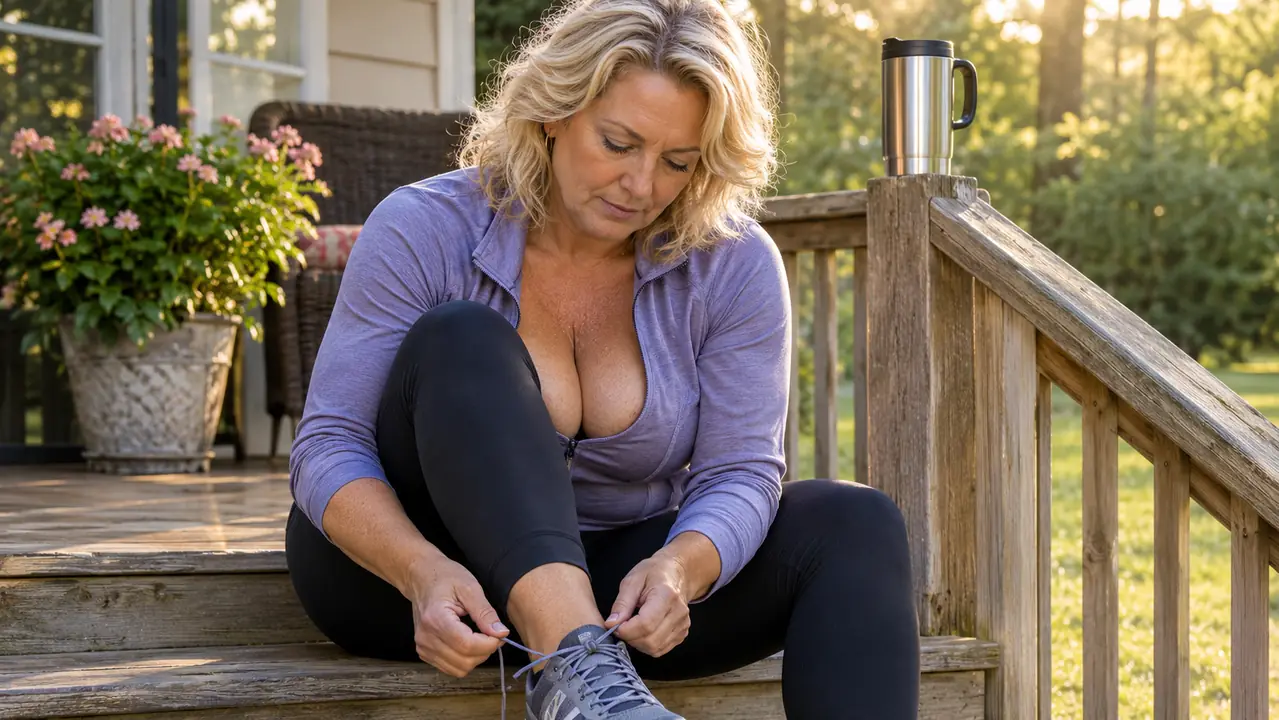
I have a bad habit of judging foot gear at hour seven of a shift, when the concrete has won and my arches have opinions. I am 56, I work part time at a hardware store in Dayton, and I walk four to five miles most days. There is a loop around my neighborhood before work and a longer trail with my husband Curtis on my days off. My feet are an 8.5 wide with arches that never showed up properly, and a couple of years ago a bout of heel pain got me serious about what I put them in. So when people ask whether the Copper Compression Arch Support Sleeve is worth it next to a plain pair of arch-support insoles, I do not give them a one-word answer.
Here is the short version. The Copper Compression sleeve is the better pick if you want support without changing your shoes, if you wear boots or sandals, or if you want something you can put on in ten seconds and forget about. Insoles are the better pick if you need cushioning under the heel, a firmer arch that holds a shape, or if the shoe itself should be doing more of the work. Neither one cures anything. They make the day more comfortable, and that is the whole job. If pain sticks around for weeks, that is a podiatrist conversation, not a shopping decision.
My first move, two years back, was the cheap route: a drugstore insole off a cardboard hanger, trimmed with kitchen scissors on the edge of the bathtub. I cut one side shorter than the other and did not notice until I was a mile in. I walked two miles and spent the second one feeling a ridge under my left arch that I could not stop thinking about. Then I put the pair in my work boots and the boots went tight across the top of my foot. They were fine in the sneakers, but I own one pair of sneakers and I stand in the boots for eight hours. That is the honest reason I went looking for something else. Not because insoles are bad. Because I wanted support in the shoes I actually wear all day, and a thick insole was not going to fit in there without a fight.
| Copper Compression Arch Sleeve | Arch-support insoles | |
|---|---|---|
| What it supports | Gentle compression wraps the midfoot and hugs the arch | A shaped arch pushes up and a heel cup spreads the load |
| Shoe compatibility | Sneakers, work shoes, boots or sandals, over or under socks | Needs a shoe with a removable liner and a little depth |
| Arch height | One size, listed for both high and low arches, so it hugs what you have | Comes in arch heights and trims to your shoe size |
| Break-in | About ten minutes on the first morning | Three or four walks before the arch stops feeling like a lump |
| Under-heel cushioning | None. It wraps the midfoot, not the heel | A heel cup and foam take the sting out of concrete |
| Sandals and around the house | Yes, it works with a sandal and a thin sock | No, it needs a closed shoe |
| Staying put | Can shift a little in a tightly laced shoe | Stays where you seat it once it is trimmed |
| Best for | Long days on hard floors without changing your shoes | Walkers who want the pavement to feel softer under the heel |
Where the Copper Compression Arch Sleeve Wins
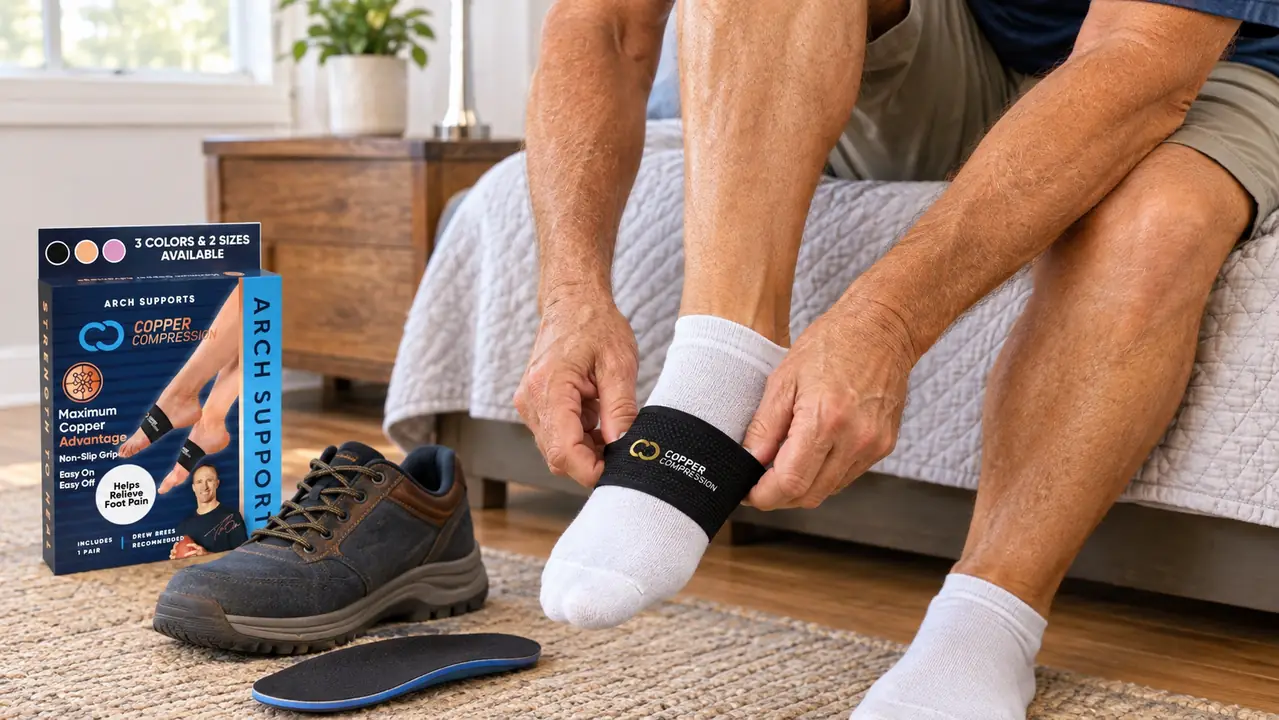
The first thing it wins is your shoes. The listing says it goes in sneakers, work shoes, boots or sandals, over or under socks, and that is exactly how I use it. I am not pulling the liner out of a work boot at six in the morning, and I am not buying a half size up to make room for something. On my days off I wear it under the strap of a sandal with a thin sock, which is a sentence I cannot write about an insole. If the problem is that your feet hurt and your shoes are fine, this is the shorter path. You put it on, you go to work, you take it off at night.
The second thing is the break-in, which is to say there is not one. It is one pair, one size, 6 by 4 by 0.5 inches and about 1.12 ounces, a slim band that wraps the midfoot and hugs the arch. The first morning I wore it I noticed it for about ten minutes and then I noticed my feet less, which is the whole goal. There is nothing to trim, nothing to slide into place, nothing that bunches under the ball of your foot when you take a corner too fast. I keep a pair in the pocket of my work bag, and I have put it on in a restroom stall before a long walk home. An insole does not travel like that.
The third is who it was built for. The listing names nurses, teachers, anyone who stands at work, and people dealing with plantar fasciitis and heel pain, and it is listed for both high and low arches. I am low. A coworker of mine is high and borrows one on her lunch break, which tells you how much shape it forces on you. It compresses and hugs. It does not lift, and it does not cushion. Keep that in your head and you will be glad you bought it. Expect it to rebuild your heel and you will be annoyed by Thursday.
A detail nobody mentions: it is a polyester blend, so it goes in the wash. I rinse mine in the sink on Saturday with the work shirts, hang it over the line, and by Sunday morning it is dry and ready. Two years of that and it has not stretched out. On a humid Dayton morning in July I notice it the way you notice a watchband, and by the second mile I have forgotten it. I have worn it through a full shift of unloading a truck and stocking shelves, and the one time it bothered me was a day I laced the boots too tight and felt the band press. I loosened the laces a notch and that was the end of it.
Take a Saturday in October. A truck came in and I spent five hours on the concrete doing the kind of work that has you stepping sideways in place, and I had a two mile walk in before my shift even started. By the end my arches were tired but they were not the loudest thing in the room, and that is the difference the band made for me. It is not that I stopped noticing my feet. It is that noticing them stopped running my day. I took the sleeve off in the car, rubbed my arches with my thumb, and drove home with the radio on like a normal person.
The sleeve changed how my arches felt at the end of a shift. Insoles changed how the pavement felt under my heel. Those are two different problems, and I stopped expecting one product to solve both.
Where Insoles Win
Insoles win the heel, and they win it easily. The sleeve wraps your midfoot, so it does nothing under the bone you land on. If your complaint is that the concrete comes up through your heel by the end of a shift, a firm insole with a heel cup does a job the sleeve cannot do at any size or weight. I walked the same three mile loop twice, once with the sleeve alone and once with the sleeve plus the insoles I already owned, and the second walk was quieter under the heel. That is not a knock on the sleeve. It is just where each one sits.
Insoles also win on arch height and shape. Mine came sized and I trimmed them to my 8.5 wide. They hold a molded arch that pushes up and keeps pushing, and after a few walks they take the shape of your foot. The sleeve is one size for a reason. It hugs whatever arch you bring to it. If your arches are very high or very flat and you want something that actually changes the geometry under your foot, that is insole work. A sleeve is support you can feel. An insole is support that changes where your weight lands.
The first week of insoles was not comfortable, and I want to be straight about that because the internet makes it sound like you slide them in and float. Mine had a hard molded arch, and for the first three walks it felt like standing on a television remote. I stuck with it a week because a coworker told me to, and by walk four the arch had softened a little and my foot had stopped arguing with it. That is the trade. The sleeve is comfortable in ten minutes, the insole is comfortable in ten miles. What you buy with those ten miles is a heel that does not throb when you get out of the truck at the end of the day, and for me that was worth the week.
The unglamorous one: insoles stay where you put them. Once trimmed and seated under the liner, mine do not move all day. The sleeve, being a band, can shift a little in a tightly laced shoe, and I have had to reach down and straighten it on a long downhill stretch. Not often, and not enough to stop wearing it, but you asked for the honest version. Insoles also live in one pair of shoes. You cannot walk them from a work boot into a sandal on a Saturday, and that is the trade you make for the firmer support.
If you do not want to change your shoes, start here
One pair, one size, about 1.12 ounces. It goes into the boots or the sneakers you already own, over a sock or under one, and it takes about ten seconds. That is the whole reason I keep a pair in my work bag.
Amazon Check Today's Price on Amazon →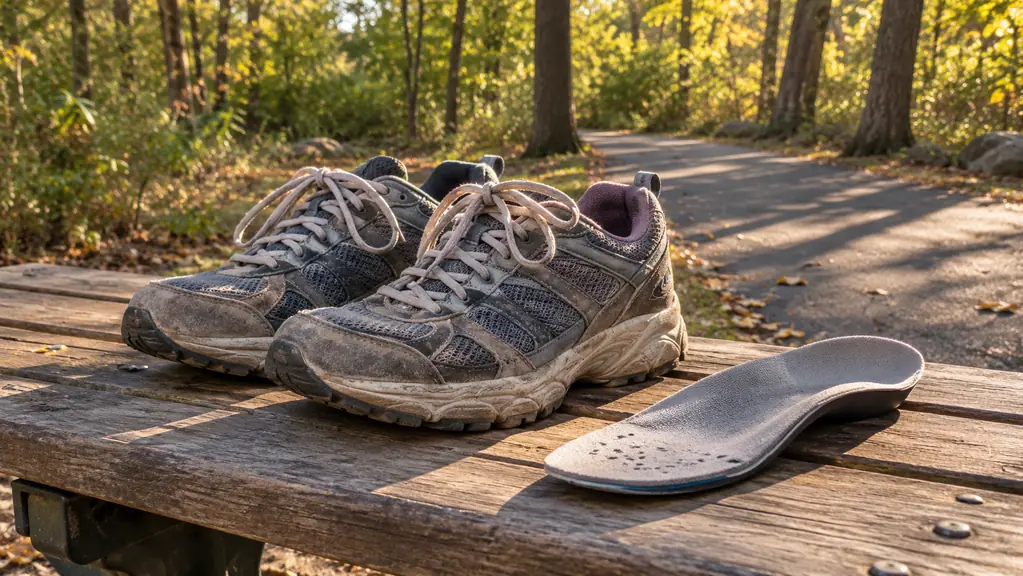
Who Should Buy Which
Buy the Copper Compression sleeve first if your shoes are the part of your day you cannot change. Work boots, dress shoes, sandals, whatever your job or your Saturday requires. Buy it if your arches ache from standing and you want something you can put on without pulling a liner out. Buy it if you have tried insoles and they felt like a lump under your foot, or if you bought a pair, trimmed them wrong, and gave up. The sleeve asks nothing of your shoes, and for a lot of people that is the whole decision.
Buy insoles first if the pain is under the heel rather than along the arch. Buy them if you want the arch actually lifted, or if you spend your miles on pavement and want the shoe to absorb more of it. Buy them if you have one pair of walking shoes you wear for everything and you do not mind seating a trimmed insole in them once. If you are doing longer distances and your heel is the loudest complaint at the end of the day, insoles are the more direct answer and I would not talk you out of them.
Buy both if you are where I was two years ago, with an arch that aches and a heel that complains. That is not a cop-out answer. They stack. The sleeve hugs the midfoot, the insole handles the heel and the lift, and together they turned my three mile loop from a chore into something I look forward to again. I wear the sleeve alone on short errands and around the house, and I wear both on the long trail days with Curtis.
One more thing before you spend anything. I keep a notebook, which sounds fussier than it is. Every pair of walking shoes gets a starting date and a running mileage written on the inside of the flap, and I retire a pair somewhere between 400 and 500 miles. The notebook is the only reason I know that. What it taught me is that some of the foot pain I blamed on my arches was really shoes that had gone flat in the sole and were quietly doing nothing for me. Before you buy a sleeve or an insole, look at the tread and the date. If you are 500 miles into a pair, no insert on earth is going to save them, and you will blame the insert. Once I started replacing on mileage instead of waiting for the uppers to fall apart, both the sleeve and the insoles started working better.
And if the pain is sharp, if it wakes you up, if it has been building for a month instead of easing, go see a podiatrist. I say that as someone who put it off for a season and regretted it. A sleeve and an insole are comfort tools. They are not a diagnosis, and they are not a cure. What they do is make the hours on your feet more bearable while you figure out the rest, and that is worth something when you stand on concrete for a living.
The pair that lives in my work bag
I will not tell you it fixes your feet. I will tell you my arches feel different at hour seven than they used to, that it slips into the shoes I already own, and that it takes ten seconds in a restroom stall before the walk home. If your shoes are the part you cannot change, this is where to start.
Amazon Check Today's Price on Amazon →