
By hour eight of a Saturday shift, my ankles have a pulse. Not a throb exactly. More like my socks have quietly gotten tighter and my shoes have gotten heavier, and I am doing the slow shuffle between the paint aisle and the register that I swore I would never do. I am 56. I work part time at a hardware store in Dayton, Ohio, and I stand on concrete for most of it. That floor does not forgive anything.
I also walk 4 to 5 miles most days, a loop around my neighborhood before a shift and a longer park trail on my days off. So my legs collect two different kinds of tired, the walking kind and the standing kind. A couple of years ago I had a stretch of heel pain that made me get serious about shoes. Somewhere in that same stretch I started paying attention to what was on my legs as well as what was under my feet. The CHARMKING compression socks became part of the routine, not as a cure for anything, just as one of the small things that makes the last two hours of a shift easier than they used to be.
Three pairs, one wash cycle a week, no rolling at the top
The 15-20 mmHg CHARMKING compression socks are the pair in my drawer that survived a full season of concrete floors. Three pairs means one on my legs, one in the mesh bag, one ready.
Amazon Check Today's Price on Amazon →Here is the order I do things in. None of it is clever. All of it took me longer to figure out than I would like to admit, and most of it I learned from getting it wrong first.
Step 1: Pick Your Pressure Before You Pick a Brand
Compression socks are sold by pressure, and that number matters more than anything else on the package. The CHARMKING pairs I wear are 15-20 mmHg. That is a mild to moderate range, and for someone who is on their feet all day but not under a doctor's care for a circulation problem, it is the range that most people I know end up in.
What I tell coworkers: if you have never worn compression before, do not go hunting for the strongest number you can find. Higher pressure is not better pressure. It is harder to get on, harder to keep on through a full shift, and more likely to leave you wanting to peel them off by lunch. I started at 15-20 and I have never had a reason to move up.
And if a doctor has told you to wear a specific pressure, use that number and not mine. This is a workday comfort habit, not a treatment plan. If your legs swell regularly, or one leg swells more than the other, that is a conversation for a podiatrist or your own doctor, not for a coworker on break.
Step 2: Put Them On Before Your Legs Ask You To
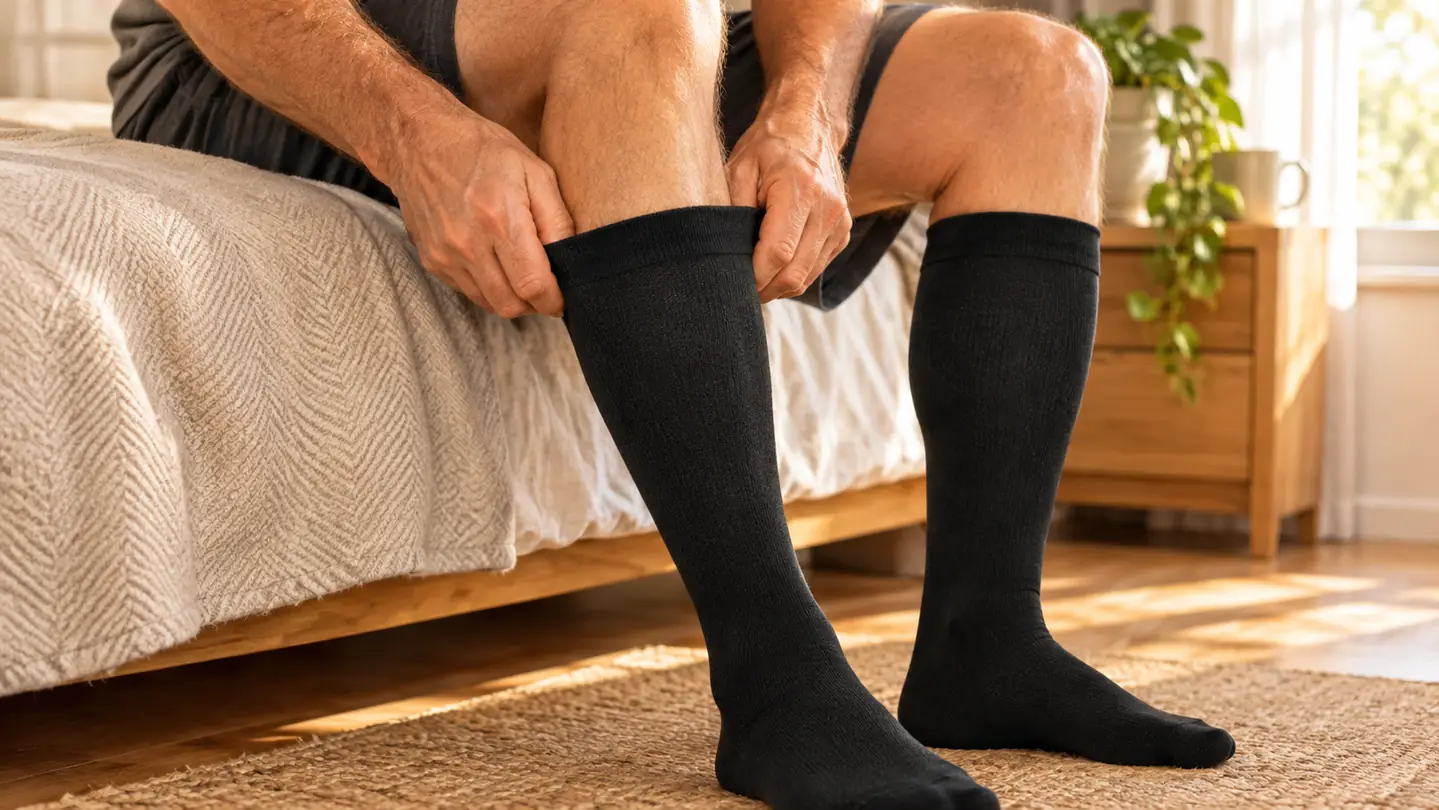
For two weeks I put them on at lunch, once my calves had already started complaining. That was backward. Compression is doing its best work in the hours before the heaviness shows up, not after. Now I put them on at home before I leave, while my legs are still fresh and the socks still go on without a fight.
I remember the Tuesday that ended the lunchtime experiment. It was the middle of February, the store was full of people buying ice melt, and I was in the second stall of the employee bathroom at 1:40 in the afternoon, hopping on one foot with my work boot in my hand, trying to work a sock up a calf that had already been standing for six hours. It took me nine minutes. I was late back from break, my back was damp, and the sock went on crooked enough that I felt a seam under my arch for the rest of the shift. That was the last time I tried to put one on mid shift.
The practical part is timing. Put them on first thing, when your skin is dry and cool. They are 85% nylon and 15% spandex, so there is plenty of give in them, but they go on a good deal easier at 6:40 in the morning than they do at 2 in the afternoon in a store bathroom.
One more thing I learned the slow way. Do not yank them by the top band. Roll the sock down to the heel, get your foot seated all the way in, then work the fabric up your calf in stages. It takes maybe thirty seconds longer and it saves you a wrestling match every single morning.
Step 3: Get the Fit Right at Both Ends
The top band should sit flat and stay flat. If it is rolling down by mid morning, the size is off, not the sock. The CHARMKING sets come in sized ranges and I wear the Large-X-Large. I am a women's 8.5 wide with slightly flat arches, and that size sits where it is supposed to without cutting in.
Sizing is where I wasted a little money early on. Before I found the CHARMKING pairs I bought a set off a rack without reading anything, and they were a size too small. I wore them twice, felt the band digging in by ten in the morning both times, and gave them to a coworker with narrower calves. The second time around I measured my calf at the widest point with a soft tape, wrote the number in the same notebook where I keep my mileage, and matched it against the size range on the package. Measure, match, then stop guessing.
The other end matters just as much. If your toes are bunched up in fabric, you will feel it around hour six and you will blame your shoes for it. Smooth the sock all the way out to the toe before you put a shoe on. Every single time, no exceptions.
Fit is also why I bought a three pack instead of one pair. Three pairs means one on my legs, one in the wash, and one in the drawer, so I am not running a load of laundry at ten at night because I only own one good pair. That sounds like a small thing. It is not a small thing.

Step 4: Build the Rest of the Shift Around Them
Compression socks are one tool. They are not a whole plan. The shifts that go well are the ones where the socks are the start of the routine and not the finish of it.
Shoes first. I wear a walking shoe with a roomy toe box and I swap out the factory insole for something with a little more support. A narrow shoe undoes anything a sock can do, no matter how good the sock is. I keep a log in a notebook of miles per pair and I retire a pair somewhere around 400 to 500 miles, which for me comes around every few months.
One thing that helped more than I expected was a rubber mat behind the register. The store had one in the back room that nobody was using, and I asked the manager if I could drag it up front. Standing on that half inch of rubber for six hours is a different job than standing on bare concrete, and it cost nothing. If your workplace has a mat sitting in a closet somewhere, go get it.
Then movement. Standing perfectly still is worse for me than walking is. On a break I take ten minutes and walk the perimeter of the lot rather than sitting in the break room. Four laps around the building is roughly half a mile, which is enough to loosen everything up without working up a sweat I have to sit in for the rest of the shift. That is not discipline. It is self defense. My legs feel better after ten minutes of walking than after ten minutes of sitting, and it took me years to believe that.
And water. I keep a bottle behind the register and I actually drink it. I am not going to pretend I am perfect about that either, but I am better than I was, and the days I forget are the days my legs feel heaviest by closing time.
Step 5: Take Them Off and Wash Them Properly
Take them off before bed, not in bed. Roll them down from the top the same way you rolled them up, and give your calves a minute to adjust before you stand up and walk to the kitchen. I learned that one after a very ungraceful evening.
Wash day in our house is Sunday morning. The three pairs go into a mesh bag with the dish towels, cold water, regular detergent, and no fabric softener, because softener coats stretchy fibers and I stopped using it on anything with spandex years ago. Then they get laid flat on a towel over the back of a kitchen chair to dry. I have never once put them in the dryer, and I think that is most of the reason mine have held up as long as they have.
The care instructions on the CHARMKING pairs say machine wash, and that is what I do. Two pairs going through a wash cycle a week has been plenty for me. When a top band starts to feel slack, that is my signal to replace, the same way mileage in the notebook tells me when a shoe is done. The first pair I retired went soft at the band somewhere around the one year mark. Nothing lasts forever, and I would rather replace a sock than pretend it is still doing its job.
What Else Helps
Two things I would add to any long shift routine, socks or no socks. The first is a second pair of shoes. Not a second pair of the same shoe, a genuinely different pair, so the foam in one has a day to spring back while you wear the other. I rotate two pairs now and both of them last longer than the single pair I used to wear into the ground.
The second is a real conversation with a professional when the ache does not quit. I say that as somebody who put off a heel pain conversation for months and regretted every one of those months. Compression socks are a comfort item. They are not a diagnosis and they are not a cure. If your legs swell, if the swelling is one sided, if there is discoloration or pain that wakes you up at night, that is a podiatrist or a doctor, full stop, no matter how many socks are in your drawer.
What I can tell you is what changed for me. The last two hours of a shift used to be something I endured. Now they are just hours. That is not a dramatic before and after, and I am not going to dress it up as one. It is a small, reliable improvement in a working day, and after a couple of years of trying things, small and reliable is what I will take.
I log miles per pair in a notebook, and I am still rotating the same three pairs of CHARMKING socks through one wash cycle a week, with no rolling at the top.
The pair that got me through the last two hours of a shift
15-20 mmHg, three pairs to a set, machine wash. Start with the mild range, put them on before your legs ask, and see how the last two hours feel.
Amazon See the Current Price on Amazon →