
Two years ago I was the person at the register shifting her weight from one foot to the other every few minutes, and by the last hour of a shift I was counting the minutes until I could sit down in the car. The floor at the hardware store is bare concrete. No mat, no give, nothing. I was standing on it for eight hours with a ten-minute break in the middle, and the shoes I had at the time were fine for a walk around the block and wrong for a whole day.
That is how I ended up working through a few different pairs and settling on the Skechers Go Walk Joy as the one I keep replacing. Not because it is remarkable. Because I could build a routine around it that got me through a shift without my heels complaining on the drive home. Here is that routine, in the order I would hand it to a new hire on her first day.
The pair I keep buying again when the old ones wear through
Slip-on, breathable, listed at 5.2 ounces, with the Air-Cooled Goga Mat insole. It is the shoe I reach for on work days, and the one I keep a second pair of.
Amazon Check Today's Price on Amazon →Step 1: Get the Size Right and Stop Guessing About It
I wear an 8.5 wide, and I have slightly flat arches that landed me in a bout of plantar fasciitis a couple of years back. That history made me fussy about sizing. The mistake I made for years was buying a half size up because it felt roomier in the store, and then spending the whole shift gripping with my toes to keep the shoe from sliding. That grip is its own kind of tired, and you feel it in your shins by the end of the day.
What finally worked was measuring my foot late in the afternoon, when it is at its biggest, and writing the number in the notebook where I keep my mileage. For a job where you stand for eight hours, width matters more than length. A shoe that is the right length and too narrow will hurt you in a way you notice at hour six rather than hour one, and by then you are stuck at work with it.
There is one more thing I do in the store, and it feels silly to write down. I try shoes on at the end of the day, after I have been on my feet, and I walk the length of the aisle four or five times before I decide. My feet at 9 in the morning and my feet at 4 in the afternoon are not the same feet, and I want the shoe to fit the afternoon version, because that is the one that has to get through the last hour.
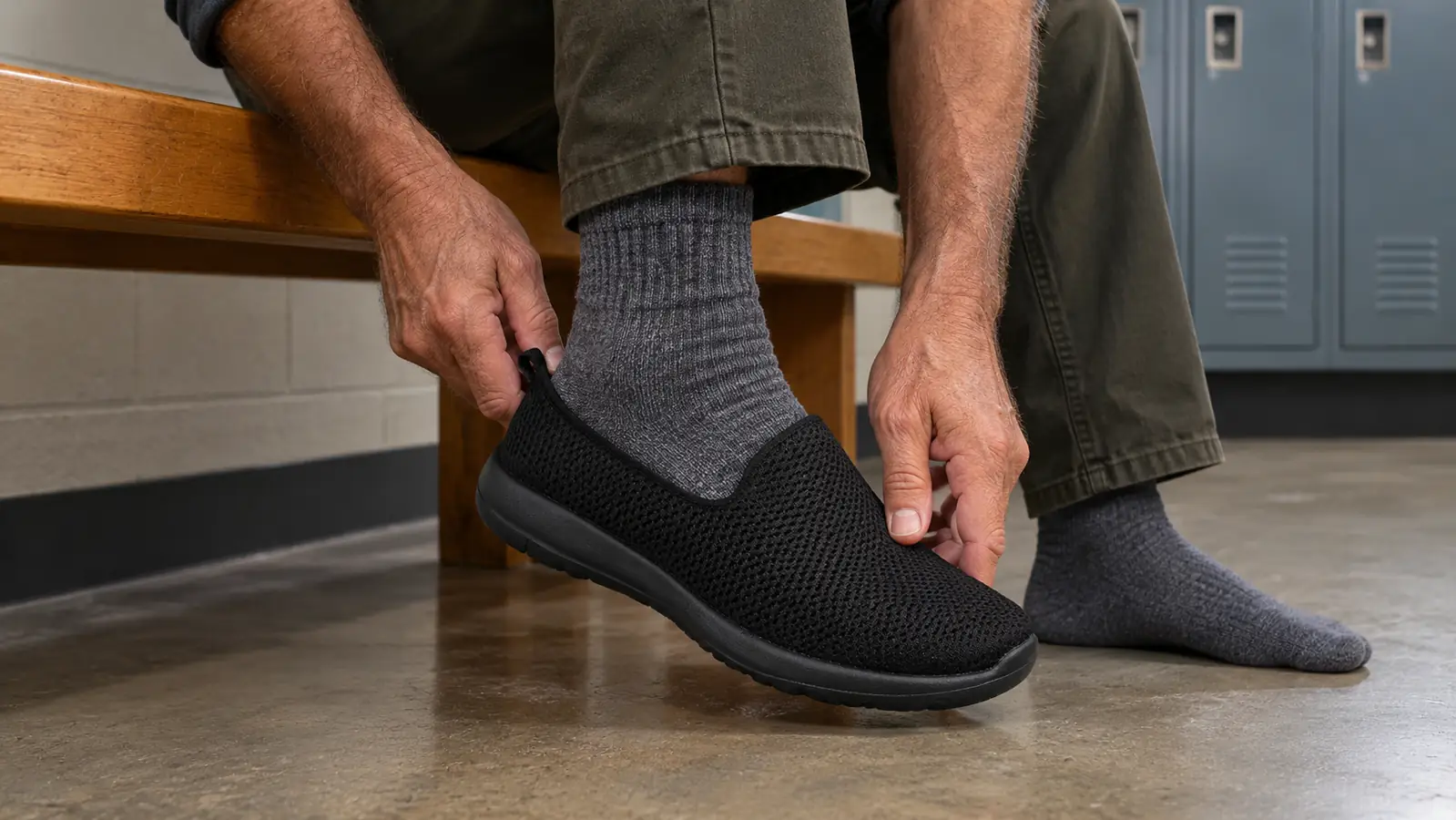
The Skechers Go Walk Joy is a pull-on, so there are no laces to snug up or loosen as the day goes on. That cuts both ways. Nothing to retie, nothing to catch on a cart wheel, and nothing to adjust either. The fit you buy is the fit you get, so try them on with the socks you actually wear to work rather than the thin ones at the bottom of the drawer.
Step 2: Break Them In on a Weekend, Not on a Shift
I made this mistake once with a different pair and I will not repeat it. New shoes went straight to work, on a Saturday, which is the busiest floor day of our week. By two in the afternoon I had a hot spot on each heel and a decision to make. I kept going. It was the wrong call, and I spent the next four days in the old pair while my heels settled down.
Now a new pair gets two short walks at home first. Twenty minutes on day one, forty on day two, both on pavement instead of a treadmill, because pavement is what I will actually be standing and walking on. Then a half shift. Only after that does a pair go into full rotation. It costs me three days and saves me a week of sore feet, every time.
The first full shift in a new pair I still treat as a test. I take the second pair of socks, I take a couple of blister plasters, and I do not wear the new ones on a day when I am covering the loading door as well as the register. A little planning on the front end means a bad fit shows up as a small annoyance instead of a reason to leave early.
The Go Walk Joy does not need much breaking in, in my experience. The upper is soft, the shoe is light, and the pair is listed at 5.2 ounces. The short walks are less about softening the shoe and more about finding the spots where it rubs while I still have the option to change socks or add a thin liner before a small rub turns into a blister.
Step 3: Match the Sock to the Shoe, Not the Weather
Nobody told me this one, so I will tell you. I spent years thinking socks were socks. Then I spent a summer in cotton crew socks inside shoes that did not breathe well, and finished every shift with damp feet and a hot, rubbed feeling across the tops of my toes.
The shoe is listed as breathable and lightweight and that has been true for me. It is also not water resistant, which matters more than the listing makes it sound. A wet walk to work means wet feet until lunch. I keep a second pair of socks in my locker now and I change them halfway through a wet day, and that one habit has done more for my comfort than any insert I have bought.
For socks I look for a thin wool or a synthetic blend that moves moisture, and I buy them slightly bigger than feels natural so no seam presses on my toes. Cotton is fine for a dry day and a short walk. Cotton on a wet morning is a mistake I have made plenty of times.
Winter is its own problem. Wool socks are thicker, and a shoe that fits perfectly in July can feel snug in January. I go up a sock weight rather than a shoe size, and if the shoe starts to feel tight across the top of my foot I switch back to the thinner sock for a week and see if it settles. It usually does.
Step 4: Rotate Two Pairs So Neither One Takes Every Shift
I learned this from the notebook more than from anywhere else. I write down the miles on each pair and I replace a pair somewhere between 400 and 500 miles. When I had one pair doing everything, work and walks and errands, I was hitting that number in a few months and the cushioning was going flat long before the outside looked worn.
Two pairs, alternating, fixed that. The cushioning gets a day to recover, the inside dries out completely between wears, and I get an honest read on when a pair is finished rather than just scruffy. One pair lives by the back door for work. The other is for the neighborhood loop before my shift and the park trail on my days off.
It also gives me a fallback. There is nothing worse than realizing at 6:40 in the morning that the work shoes are damp through or worn at the heel and there is nothing else to put on. Two pairs turns that into an annoyance instead of a bad day on concrete.
Step 5: Treat the End of the Shift Like Part of the Job
You cannot buy your way out of eight hours on a concrete floor. The right shoe helps. It does not undo the day. What helped me most was five minutes at the end of the shift, before I got in the car.
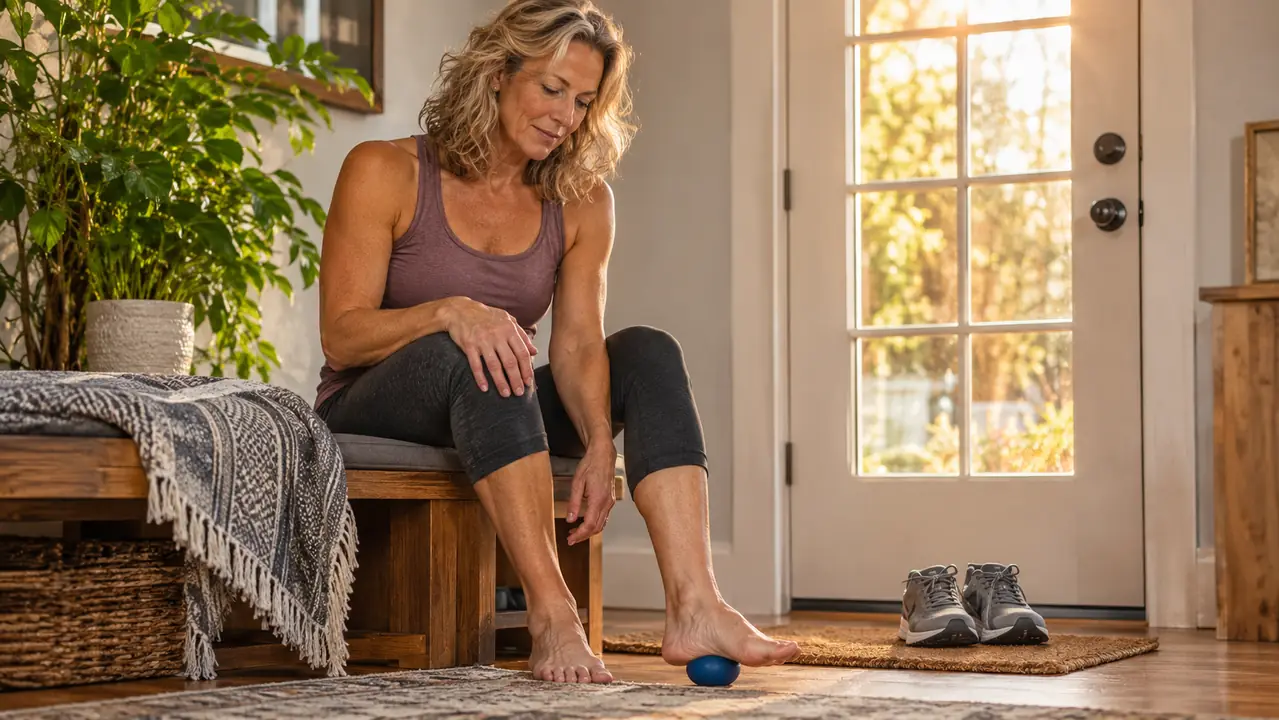
Shoes off, socks off, and I roll each foot over a firm ball for a minute or so. Then I stretch my calves against the wall by the break room door, thirty seconds each side, twice. Then I put on a different pair of shoes for the drive home. That last part sounds fussy. It is not. My feet are a different shape at 4:30 than they were at 8 in the morning, and the work pair no longer fits that shape.
The drive home matters more than people think. Dayton traffic is not Los Angeles traffic, but twenty-five minutes with your foot on a pedal after eight hours standing is twenty-five more minutes in the same position. Changing shoes before I get in the car is the easiest thing on this list, and it costs nothing at all.
When I get home I put my feet up for ten minutes and I stretch the calves again after my walk on days off. The heel pain I had a couple of years ago came back once, during a stretch when I got lazy about all of this. It has not come back while I have stayed with it.
The notebook says 400 to 500 miles out of a pair. Rotating two of them is what makes that number last a working season.
A Week in the Rotation
I walk four to five miles most days. On work days it is a loop around the neighborhood before my shift, about two miles, and then whatever the shift itself involves, which on a floor day is a lot of standing and a fair amount of walking between the aisles. On my days off Curtis and I do a longer trail at the park, four or five miles depending on how we feel and how hot it is.
The work pair never goes on the trail. The trail pair never goes to work. That sounds rigid, and it is on purpose. Keeping the two jobs separate is how I know which pair is wearing out and why, and the notebook only tells me anything useful if the entries mean something. When the trail pair starts feeling thin under the ball of my foot, I know it is close to the 400 mile mark without having to guess.
Where They Fall Short
Two things I would change. The first is water. The Skechers Go Walk Joy is not water resistant at all, and we get wet mornings here in spring and again in fall. There is no version of this shoe that handles a puddle on the walk in, so on those days I either drive or carry a change of socks.
The second is the slip-on fit itself. If you have a narrow heel, there is nothing to tighten, and your heel may move more than you like over a long day. That was never my problem, since my feet are the other way around, but Curtis tried a pair and went back to a lace-up for exactly that reason. Worth knowing before you order.
What Else Helps
A few things outside the shoe that made a difference. I asked my manager for an anti-fatigue mat at the register and got one, and standing on it for the last three hours of a shift is a different job than standing on bare concrete. If you have any say at all about the floor, use it.
On days when my arches are complaining I put a thin insert of my own in on top of the insole, and it has fit without crowding my toes. I also keep a pair of shoes in the car that are not work shoes, so my feet get a change on the drive home and on the walk from the lot.
One more thing, and it is not about gear. My walking changed when I stopped taking long strides on the pavement. Shorter steps, quicker turnover, and I land more under myself instead of out in front on my heel. It took a couple of weeks to feel normal. My knees noticed the difference before my feet did.
And know where the line is. Shoes help you stay comfortable. They do not fix a foot. If pain lasts more than a couple of weeks, or if it wakes you up at night, that is a conversation with a podiatrist, not another pair of shoes. I say that as someone who spent a month shopping instead of making the call, and I would have saved myself a lot of guessing.
If your shift ends with your feet throbbing, start with the shoe
The Go Walk Joy is the pair I keep replacing, and the five steps above are what make it work on a concrete floor. Check today's price and see if your size is in stock.
Amazon Check Today's Price on Amazon →