
Six months ago I did something I should have done two years earlier. I pulled the factory insoles out of my walking shoes and dropped in a pair of PowerStep Pinnacle insoles. I am 56, I work part time at a hardware store in Dayton, Ohio, and I spend six hours a shift on concrete. I walk four to five miles most days, a loop around the neighborhood before work and a longer park trail on my days off. My feet are size 8.5 wide with arches on the flat side, and a couple of years back I had a stretch of heel pain that got me serious about what I put under them.
Before the Pinnacle I tried the cheap end of the shelf. Gel heel cups from the drugstore that flattened into nothing inside a month. Thin foam inserts that felt like a sock with ambition. One pair of cushioning insoles that were soft as a pillow and gave me nothing under the arch, so my foot rolled inward all day and my knees filed a complaint by Thursday. What I wanted was simple. An arch that held its shape past week three, a heel that did not thud on concrete, and a fit that worked inside shoes I already owned. The PowerStep Pinnacle is the closest I have come to all three at once.
The Quick Verdict
A firm, shaped arch that survived six months of concrete floors and everyday walking. Not soft, not custom, and worth the adjustment period.
Amazon Check Today's Price →The insole that finally stayed in my walking shoes past month two
Six months in, the arch on my pair still stands up when I press my thumb into it. They are sold in numbered sizes matched to your shoe size, so check the listing against your own shoes before you order.
Amazon Check Today's Price on Amazon →How I've Used It
I rotate two pairs of walking shoes. A neutral trainer for the road loop, and a roomier pair for the park trail. The Pinnacle went into the road shoes first, because the road is where the concrete is. Setup took half a minute. I lifted the factory insole out, set the PowerStep pair in its place, and laced up. The pair weighs 2.4 ounces, so I cannot tell you it made my shoes heavier, because it did not.
The first week I noticed the arch with every step. Not in a sore way. In a something is finally under my foot way. My arches are low enough that most shoes feel like standing in a shallow bowl, and I had gotten used to that gap. The Pinnacle is built with a shaped arch that rises to meet the foot. The material is EVA, a firm foam, and it does not squish the way the pillow insoles did.
By the end of week two I had stopped thinking about them, which is the best thing I can say about an insole. I wear them for the whole shift, six hours standing with a hundred trips up and down the aisles, and then I walk my loop in the same shoes. I keep a notebook log of miles per pair of shoes and I retire shoes somewhere around 400 to 500 miles. The insoles get tracked on the same page, which is how I know where they stand.
I should say what I compared them to, because that is the fair question. My husband Curtis walks the weekend trail with me and he has been in a different brand of arch support for a year, and I have borrowed a pair of his for one long walk. His are softer underfoot. Mine hold their shape better at the end of a shift. Neither of us is right about the other one. My advice is to try a single pair and give it a week of real walking before you decide, and that is exactly what a return window is for.
What the Pinnacle Actually Is
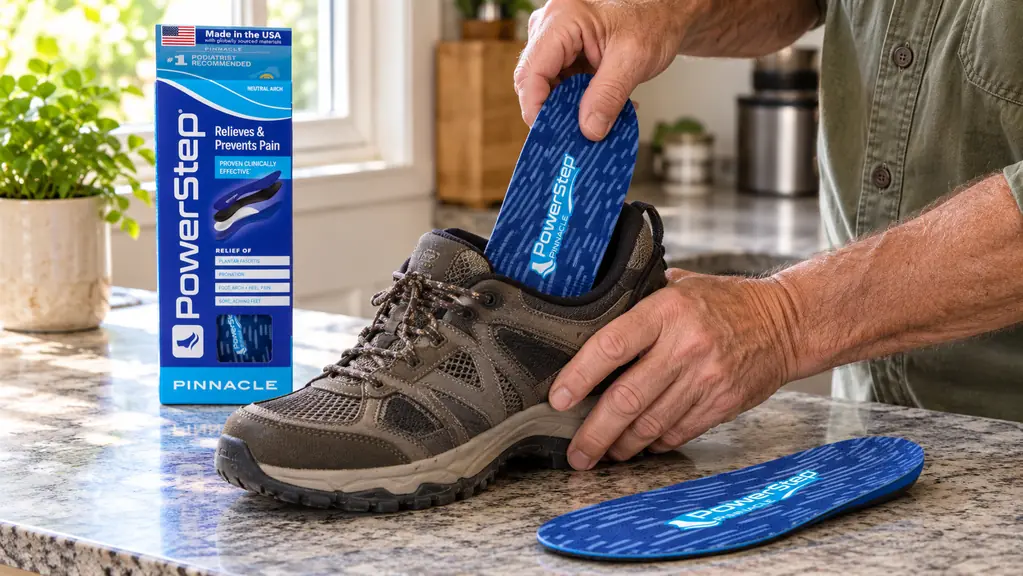
Here is what the listing says, in plain terms. PowerStep sells these as a podiatrist-recommended insole with maximum cushioning and arch support, and heel cushioning is the part they lead with. They are made in the USA, they come with a 30-day money-back guarantee, and the listing says they can be worn in a range of shoe types including athletic shoes. The pair I have weighs 2.4 ounces and the packaged set measures 13.5 by 4.5 by 1.8 inches, which tells you the box is bigger than what is inside it.
The fit details that matter: the Pinnacle is a neutral arch insole with corrective support, medium shoe width, built from EVA. Neutral arch means it is shaped for a foot that does not need a deep, aggressive wedge built into it. If you have very high arches, or a foot that has already been fitted for a prescription orthotic, this is not that product and it does not pretend to be. It is a supportive insole you put into a shoe you already like.
I want to be careful here, because I am not a podiatrist and I am not going to play one in a review. These insoles help comfort. They do not cure anything. My heel pain a couple of years back got handled with a podiatrist visit, better shoes and a lot of boring stretching, and the insole was one piece of that, never the whole answer. If your heel or arch has been hurting for weeks, book the appointment first. Then come back and read about insoles.
A Full Day on Concrete, Six Hours In
The heel is where I noticed the difference first, because concrete punishes a heel. Standing at a register for six hours, my heel used to take the whole load with nothing between it and the floor but a thin factory footbed. With the Pinnacle in, the landing is quieter. That is the only word I have for it. I still feel the floor. I just do not feel it in my heel bone.
The arch does more than I expected. When your arch is supported, your foot stops working so hard to hold itself up, and by the end of a shift my feet were less tired and my lower legs were less cranky about the stairs at home. I cannot prove a mechanism and I am not going to try. I can tell you what six months of my own notebook says, and it says the last two hours of a shift stopped being the worst two hours.
The weekend tells a different story. On the park trail I am out for two hours on dirt and gravel, and there the insole is less about cushioning and more about the arch staying where it belongs. What I noticed on the long walks is that my feet stopped aching in the final mile, which used to be the mile I dreaded.
Where they fit well: my walking shoes and my trail pair, both with laces I can loosen. Where they did not: a pair of slip-on shoes I wear to church. The insole took up enough room that my toes felt crowded, and the medium width was not going to change itself for me. If you have wide feet and snug shoes, expect to loosen the laces or leave the insole out for that pair. One pair of insoles lives in one pair of shoes, and that is the honest limitation.
Where the Pinnacle Falls Short
The first three days are not comfortable. The EVA is firm, and firm is the whole point, but your foot has to get used to it. I wore them for a couple of hours at a time the first two days, then went to full shifts. If you put them in and walk five miles on day one and decide you hate them, you did what I nearly did.
They take up volume. My walking shoes are sized for a wide foot and I still loosened the laces a notch for the first week. Anything with a shallow toe box is going to feel tight, and there is no version of this where a firm insole adds height under your arch and adds no room in the shoe.
They are sold in numbered sizes rather than one universal pair, so you have to know your shoe size and order against it instead of guessing and hoping. And one pair covers one pair of shoes. If you rotate three pairs of shoes the way I do, you are either swapping insoles every morning or buying more than one pair. I did the swapping for a month, and it is as annoying as it sounds.
Last thing, and it is the one I would want to know before ordering. This is not a soft insole. If you want the feeling of walking on marshmallows, the gel pads will give you that and the PowerStep will not. I wanted support. I got support. Softness was the trade, and I made it on purpose.
About that 30-day guarantee. Thirty days is enough time to learn whether an insole agrees with your foot. It is not enough time to learn whether it lasts. Those are two different questions, and I can only answer the second one because I kept mine well past the window.

Six Months Later
I pulled them out this week to look at them. The top cloth shows compression under the ball of my foot and the edge at the heel is a little polished from sliding in and out of shoes. The arch has not collapsed. I pressed my thumb into it and it came back. The heel pad is thinner than it was in March, but it is still doing its job on concrete, and six months of daily walking plus six-hour shifts is a lot to ask of a foam insole.
If I did it again I would buy two pairs on day one, mark the left and right with a marker so they do not wander between shoes, and replace them when the heel stops feeling like anything underfoot. That is the check I use now. Not how the top looks. Whether the heel still feels like something between me and the floor. Mine are due, and I already know which pair I am ordering.
What I Liked
- The arch held its shape through six months of daily walking and full shifts on concrete
- Heel cushioning is the real difference on hard floors, not the marketing line
- Firm EVA base instead of soft foam, so it does not flatten in a month
- Fits inside ordinary walking and athletic shoes that have a removable factory insole
- 2.4 ounces for the pair, so you will not notice the weight
- Made in the USA and backed by a 30-day money-back guarantee
Where It Falls Short
- Firm enough that the first two or three days are an adjustment
- Takes up room in the shoe, so snug toe boxes and slip-ons are a problem
- Sold in numbered sizes matched to shoe size, so you have to order correctly
- One pair covers one pair of shoes, which is a hassle if you rotate shoes
- Not soft, and not a substitute for a prescription orthotic
Six months, roughly 700 miles of walking and a lot of hours on a concrete floor, and the arch on my pair still stands back up when I press my thumb into it.
Who This Is For
This is for the walker who is on their feet for a living and wants an arch underneath them, not a pillow. It suits low to neutral arches, the person who has tried the soft drugstore inserts and watched them disappear in a month, and anyone who walks three to five miles a day on sidewalks and hard floors. It fits athletic and walking shoes with a removable factory insole. If your job is standing at a register, a counter or a machine, that is the exact use this insole is built around, and it is where I got my money's worth.
Who Should Skip It
Skip it if you want a soft, squishy ride, because you will be disappointed and you will blame the insole for it. Skip it if a podiatrist has already fitted you for a prescription orthotic, since this is not that and is not meant to be. Skip it if your shoes are already snug, because it needs room to work. And if your foot or heel pain is sharp, new, or getting worse instead of better, skip the shopping entirely and get looked at first. Insoles help comfort. They are not a diagnosis.
The pair I would buy again, and I am about to
Same size, same shoe, second set. If you stand on hard floors all day and want an arch that lasts past month three, this is where I would start. Check the size on the listing against your own shoes first.
Amazon Check Today's Price on Amazon →