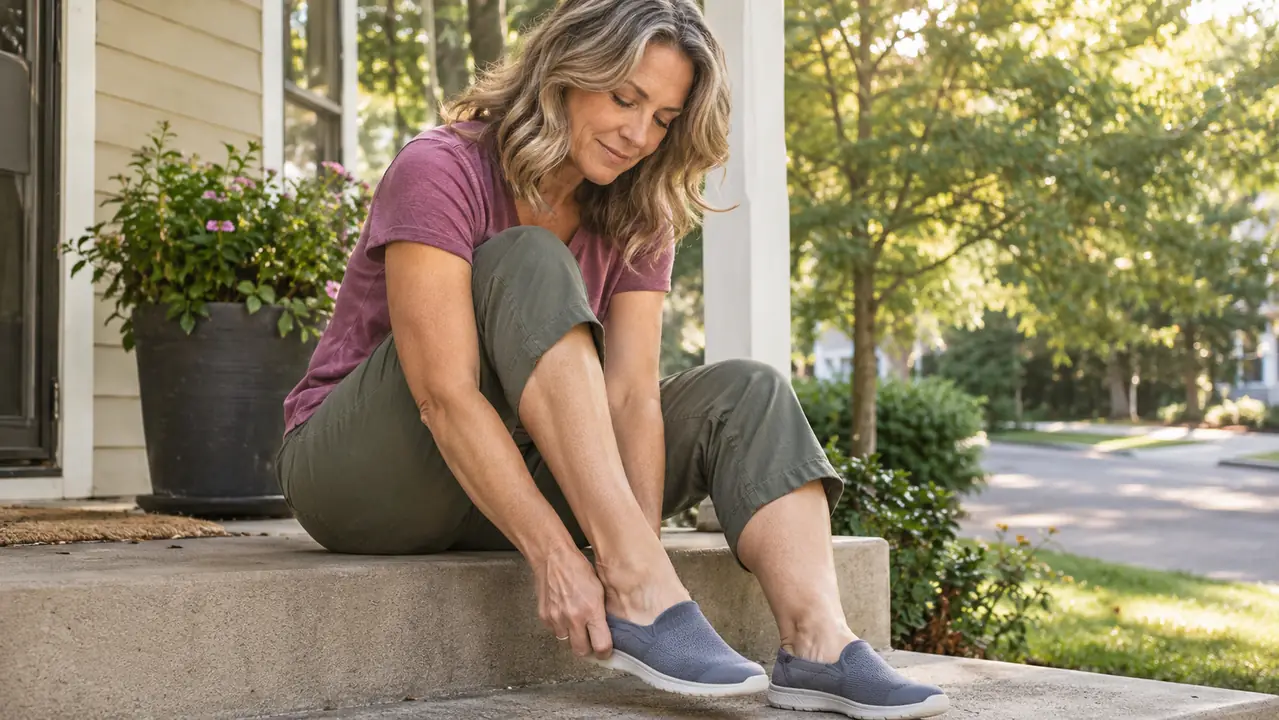
I have bought this shoe twice. That is the shortest honest review I can give you, and it is also the reason this page is going to spend more time on the cons than most reviews of the Skechers Go Walk Joy do. If a shoe gets a second pair out of me after 400-plus miles on concrete, it earned it. But I am not going to pretend the second pair was identical to the first, or that it fixed the thing that bothered me about the first.
I am 56, I work part time at a hardware store in Dayton, Ohio, and I walk 4 to 5 miles most days. A loop around the neighborhood before my shift, a longer park trail on my days off. My feet are a women's 8.5 wide with arches on the flatter side, and I had a rough stretch with heel pain a couple of years back that made me take shoes seriously for the first time in my life. Concrete floors at work, asphalt on the walk. This is what that combination has taught me about this particular slip-on.
The Quick Verdict
A genuinely comfortable, genuinely light pull-on that is wonderful for errands, standing and short walks. It is not a stability shoe and it will not carry you 10 miles, so buy it for the job it actually does.
Amazon Check Today's Price →If you want the lightest thing on your feet for errands and standing all day, start here
The Go Walk Joy weighs 5.2 ounces per shoe, pulls on with no laces, and has the Air-Cooled Goga Mat insole underfoot. That is the whole pitch, and for a lot of walkers it is enough.
Amazon Check Today's Price on Amazon →How I've Actually Used Them
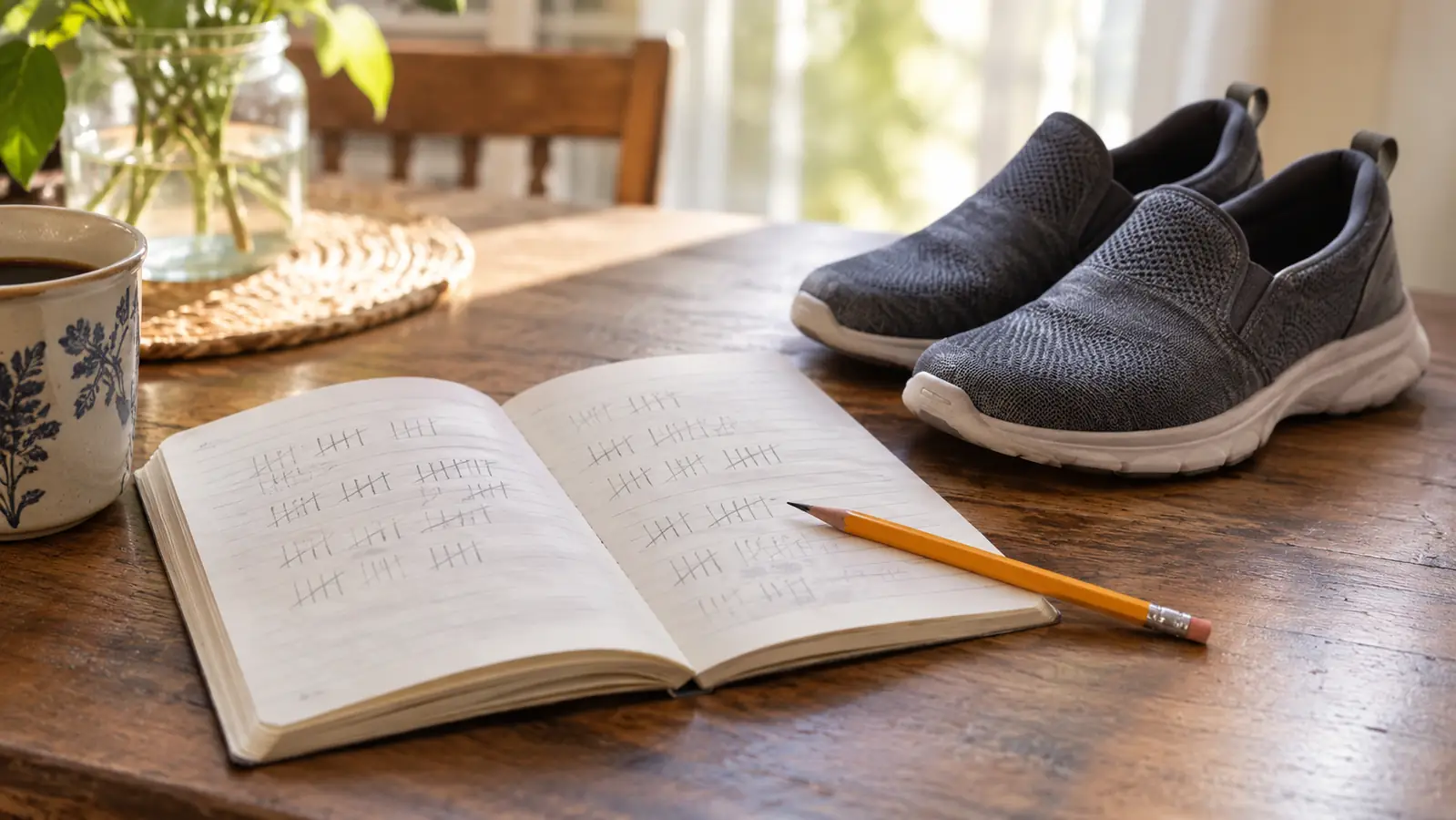
My first pair went on in March and came off for good in late August, about 430 miles according to the tally I keep in a spiral notebook on the kitchen counter. I am not precious about it. I write the date I start a pair, I add up my walking miles, and when the shoe starts talking to me I retire it. Four to five hundred miles is where I draw the line, and I have never had a pair go much past that without the midsole flattening out.
Those 430 miles were not all trail miles. Most of them were the walk to and from work, the aisles of the store, standing at a register, and the paved loop around my neighborhood at 6:40 in the morning. I wore them to the grocery, to the dentist, on a trip to see my sister in Columbus where I stood in a museum for three hours. The park trail near me is crushed limestone and it is where the shoe's limits showed up first.
One morning in June sticks with me, because it was the day I stopped wondering whether these were worth keeping. A truck was coming in, so I had a nine hour shift on the schedule. I walked my loop before it, 3.4 miles according to the log, and then stood on that concrete floor until 5:30 in the afternoon. My feet were tired at the end of it, and I am not going to tell you otherwise. But they were tired the way legs are tired after a long day. They were not hot and swollen and fed up with me. I drove home, kicked the shoes off at the door, and made dinner standing at the stove without thinking about my feet once. That is the test I care about now, more than any number printed on a box.
The second pair is on my feet now, roughly 190 miles in, and I have been watching for the same things. So this is not a first-impressions review. It is the version I would give a coworker on break, including the parts where I tell her to think twice.
What Nobody Tells You Before You Buy
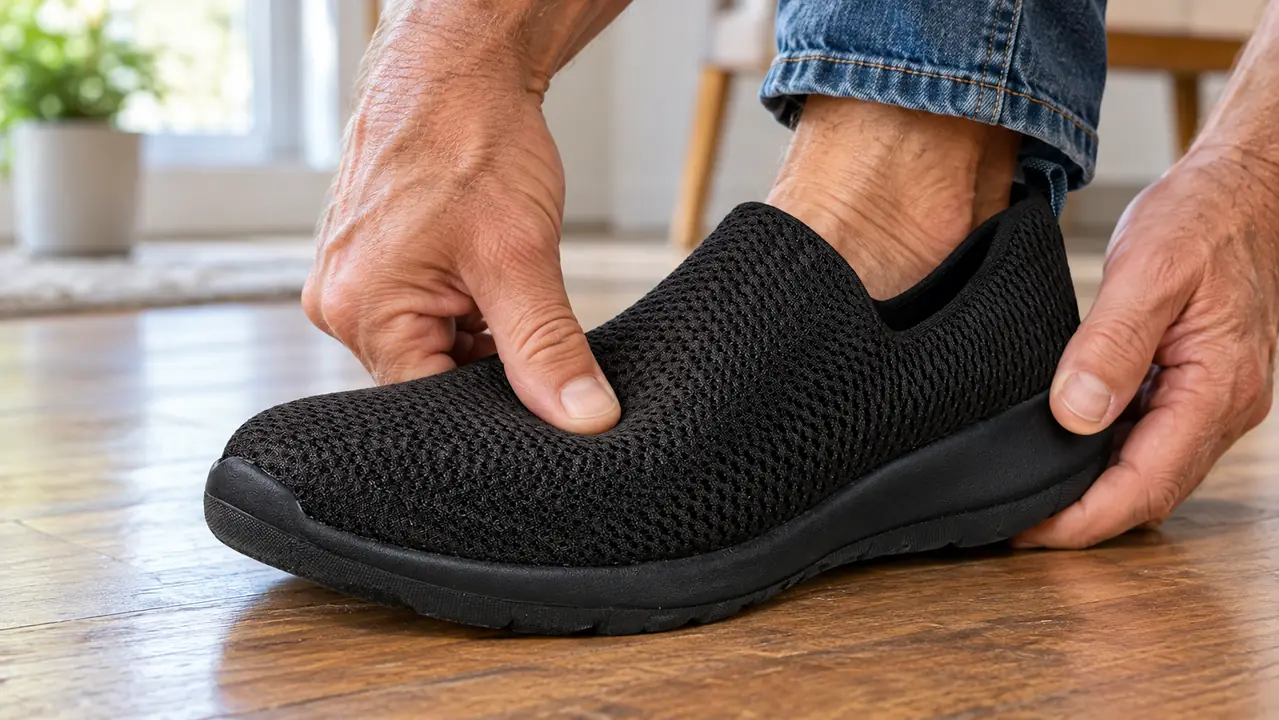
Here is the first thing the product page does not say out loud. That pull-on collar is the whole reason to buy this shoe and it is also the reason the shoe ages the way it does. There are no laces to tighten. Nothing to micro-adjust. You slide your foot in and the fabric upper has to do all the holding by itself.
For the first hundred miles that is a lovely feeling. It is like wearing a sock with a sole. Somewhere past that, the upper relaxes. Mine did, both pairs. Not to the point of falling off, but enough that on a longer walk I could feel my heel lifting a hair on the push-off. That is the honest tradeoff and no review that opens with how soft it is will mention it, because it is not a defect. It is what a lace-free shoe is.
I measured the thing that bugged me, because I am that kind of person. I laid a tape measure across the opening of the first pair on the day they arrived and again in early July. The opening had widened by roughly three eighths of an inch. That sounds like nothing. Three eighths of an inch is the difference between a shoe that feels like it is holding you and one that feels like it is along for the ride. On flat pavement I could not tell you which pair I had on. On the sloped stretch of my loop, the piece of sidewalk that drops toward the creek, I could feel my foot slide forward a touch on the downhill side. Not enough to blister anything. Enough that I noticed, and I am the one who has to walk in them.
Second thing. The insole is listed as the Skechers Air-Cooled Goga Mat, and it is genuinely cushioned and genuinely breathable. What it is not is a support orthotic, and it does not pretend to be. If you are somebody who needs arch support added to a shoe, plan on replacing or supplementing that insole and going up a half size to make room. I did exactly that on the second pair and it changed the fit in a way I had to get used to.
Third thing, and this one costs people money. The shoe is not water resistant. The listing says so plainly. Most people skim right past it. I walked through wet grass at the park in April and had damp socks in under a minute. If your daily loop involves dewy grass, slush, or puddles, this is a fair-weather shoe and you should hear that before you order rather than after.
The pull-on collar is the whole reason to buy this shoe, and it is also the reason the shoe ages the way it does. No laces means the upper has to do all the holding.
Where It Genuinely Shines
Standing still. That is the answer, and it is not a joke. On the concrete floor at the store I can be on my feet six hours and my feet do not have that hot, swollen, done-with-you feeling at the end of a shift. The cushioning under the ball of the foot is real, and 5.2 ounces means my legs are not dragging by two in the afternoon. I have worn heavier walking shoes that made me more tired standing than walking.
It is also the easiest shoe to put on that I own. No bending, no tying, no untying when I come in the door. I have arthritis creeping into my right thumb, which sounds dramatic and is really just a nuisance, and I notice when a shoe requires me to work at it. This one does not.
And the breathability is not marketing filler. My feet run warm. In a closed leather shoe my socks are damp by the end of a shift. In these, through a Dayton summer, that did not happen. The fabric upper lets air move. That is worth something to anyone who has peeled off a shoe at the end of a long day.
For the shorter neighborhood loop, three miles on sidewalk and asphalt, they are exactly right. Light, quiet, no break-in, no blisters, nothing to think about. Those mornings are the reason I bought the second pair.
Where It Falls Short
Longer distances. I took them out for a six mile park loop once, on crushed limestone, and I would not do it again. Not because anything hurt, but because by mile five I could feel every small stone through the sole and the shoe was asking me to work harder than a shoe should ask. This is a walking shoe for the short to moderate end of the range and it makes no claim otherwise, but people read "walking shoe" and assume it covers a 10K, so here is your warning.
I gave the trail a fair second try in early May, on the loop that runs out past the soccer fields and back, 4.2 miles round trip on paper. The first mile was fine and I was feeling smug about it. The second mile I started noticing the gravel through the sole. By the third I was picking my way around the bigger stones instead of walking the way I normally walk, which is a bad sign in any shoe. I finished, nothing hurt, and I have not worn them out there since. My regular walking shoes are heavier and clunkier and I do not think about the ground at all in them. That trade is worth naming out loud.
Uneven ground is the other one. The sole is soft, which is comfortable on flat pavement and vague on anything else. On the limestone trail I had to pay attention to where I was stepping in a way I do not in a firmer shoe. If your walk is rooted, gravelly, or hilly, this is a sidewalk shoe being asked to do a job it was not built for.
The durability is what it is. Around 400 miles the midsole in mine was visibly compressed, and the fabric at the outer edge of the collar was starting to look tired. That is not a complaint exactly, because I got 400 miles out of a light shoe and that is a reasonable return. But if you are looking for a pair to last two years, this is not that pair. Soft and light and long-lasting do not all live in the same shoe in my experience.
And the fit is not generous. I am an 8.5 wide and I ordered an 8.5 wide and it was snug through the middle of the foot on the first pair. Not painful. Snug. The second pair loosened up within a couple of weeks the same way, so if you are on the edge between sizes, go up. I would rather tell you that than have you find out on your own.
What I Liked
- Genuinely light at 5.2 ounces per shoe, which shows up in how your legs feel at the end of a shift
- No laces, so it goes on and off without bending or untying
- Air-Cooled Goga Mat insole is cushioned and it does keep feet from getting that hot, swollen feeling
- Breathable fabric upper, comfortable through a humid summer
- No break-in period at all, comfortable from the first walk
Where It Falls Short
- The upper relaxes after a couple hundred miles and the heel starts to lift slightly on push-off
- Not water resistant, so wet grass means wet socks
- Around 400 miles the midsole compresses noticeably
- Soft sole is vague on gravel, roots and uneven trail
- Runs snug through the midfoot, so consider going up a half size
The Sizing Question Nobody Answers Well
Let me be specific, because vague sizing advice is useless. My foot measures a women's 8.5 wide, and in most athletic shoes an 8.5 wide fits me with a thumb's width at the toe. In the first pair of these, the length was right and the middle of the shoe was tight enough that I noticed it for the first two weeks. The wide width helped at the ball of the foot. It did not add room through the instep, because there is nothing to loosen there.
On the second pair I went with the same size but swapped in a thinner aftermarket insole for the first month, then put the original back once the upper had relaxed. That worked well and I would do it again. If you are between sizes, or if you have a high instep, order up. The shoe will not tighten back up for you the way a laced shoe will.
I did test the half size up, because I did not want to hand out advice I had not checked myself. I ordered a 9 wide in the second pair, wore them around the house for a week, and sent them back. Too long. In a shoe with no laces, extra length means your heel slides, and mine did, right at the back on every step. So the honest answer is narrower than a rule. Stay in your usual size if it is comfortable across the ball of your foot. Size up if you are already between sizes, if your instep runs high, or if you plan to put a thicker insole in. Otherwise the extra length works against you.
One more thing worth saying plainly. This is a slip-on. If you pronate heavily, or if a podiatrist has told you that you need motion control, a soft lace-free shoe is not the answer no matter how comfortable it feels in the store. Comfort and support are two different jobs and this shoe only took one of them.
Who This Is For
You are on your feet a lot but you are not covering huge distances. Retail, a register, a kitchen, a nurse's station, a school hallway. You want something light that you can kick off at the door and that will not leave your feet throbbing at 3pm. That is the person this shoe was made for and it serves her well.
You also want simplicity. If bending down to tie a shoe has become a small annoyance in your day, or if you have a thumb, a back, or a hip that makes laces a chore, the pull-on design is worth more than any specification on the box. I did not understand that until it applied to me.
And you walk on pavement, sidewalk, and indoor floors. Two to four miles at a stretch, most days. Fair weather, mostly. I have told two women at work to look at the Skechers Go Walk Joy for exactly this reason, both of them on their feet all shift and neither of them walking long distances, and both of them came back saying their feet felt better by the end of the day. If that is your life too, this is a sensible, comfortable shoe and I understand why it has the following it does.
Who Should Skip It
If your walks are long. Five miles is where mine started asking questions and six was the last time. If you are training for a half marathon or doing 8 mile Saturday hikes, get a firmer walking shoe with more underfoot structure and save this one for errands. That is not a knock on Skechers, it is a knock on buying a light slip-on for a long walk and expecting it to behave like something else.
If you need real support. Heavier walkers, high arches that need cushioning in a specific place, anyone with a diagnosed foot condition that a podiatrist is actively treating. This shoe gives you cushion and a breathable upper. It does not give you stability, and a soft slip-on is the wrong tool for that job. If pain is persistent, that is a conversation with a podiatrist, not a shoe review, mine included.
And if you walk in wet conditions, or on trails, or you want one pair to last you two years of daily miles. Three different reasons, all of them real, all of them reasons this particular shoe is not the one.
Buy it for the standing, the errands and the three mile loop, not for the 10K
5.2 ounces, no laces, breathable upper, Skechers Air-Cooled Goga Mat insole. Know what you are buying and it will treat you well. On Amazon it comes in wide widths, which matters if you are an 8.5 wide like me.
Amazon Check Today's Price on Amazon →