

Four miles into my loop last March, my right arch started talking to me. Not a sharp pain, just a dull ache that showed up in the same spot every time, the way it does when you spend six hours on a concrete floor and then ask your feet to carry you another four miles. I had already tried the drugstore inserts. They flattened out in about three weeks. A coworker at the hardware store handed me a pair of PowerStep Pinnacle insoles and told me to give them a month before I made up my mind. I did, and this list is what changed.
I walk four to five miles most days. I am 56, I work part time in a hardware store in Dayton, and my feet are a women's 8.5 wide with arches that never quite showed up. I am not a podiatrist and I am not going to write like one. What follows is ten reasons arch support made a difference for a walker like me, and the honest limits, because an insole is a comfort product. It helps. It does not cure anything, and if your pain sticks around, get yourself to a podiatrist.
The insert that holds the middle of your foot up
If your arch is doing nothing in your current setup, this is the simplest way I know to find out whether support changes your walk. It changed mine.
Amazon Check Today's Price on Amazon →The middle of your foot finally gets held up
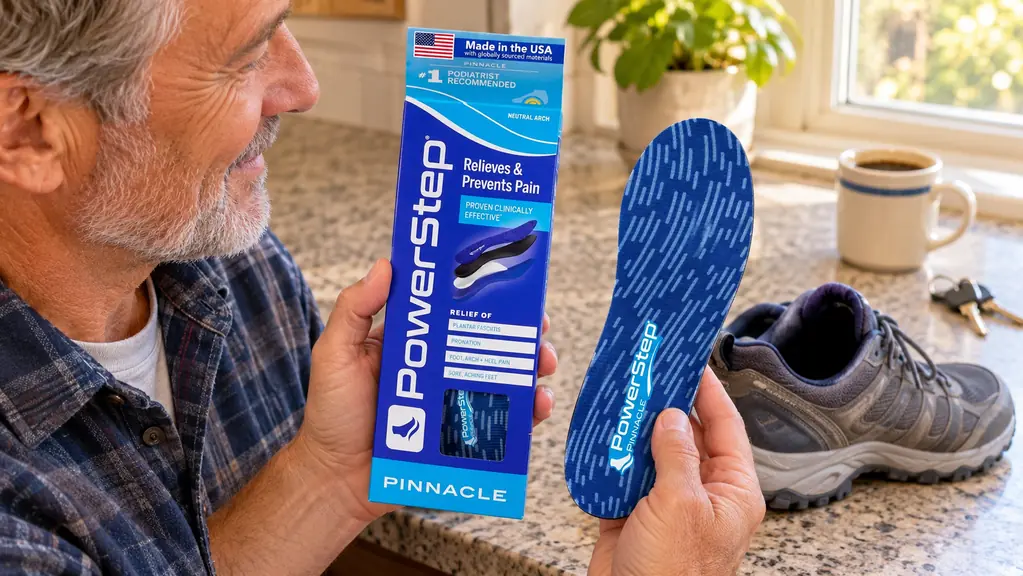
Every cheap insert I bought before this was a heel pad with a thin sheet of foam in front of it. My arch got nothing from that arrangement. The Pinnacle has a molded arch support built into the insole itself, so when I stand down the middle of my foot is being held instead of rolling toward the floor. That is the difference I noticed on the first walk, not the third week. If your arches are slightly flat like mine, you will feel it right away in the shoe.
Six hours on concrete stops following you home
Hardware store floors are unforgiving. By two in the afternoon my feet used to ache, and by the time I got to my car I was walking on the outside edges of my shoes. The cushioning in these runs along the length of the foot instead of stopping at the heel, so the part that takes the pounding at work is the part that gets the help. I still notice a long shift. I just don't notice it on the drive home anymore.
The heel lands softer on every step
The feature list calls out superior heel cushioning, and that is the piece I would have paid attention to two years ago when heel pain had me limping out to the mailbox. A softer landing at the heel means less of that jolt up the back of the leg with every step. I am not going to tell you an insole cures anything. I will tell you my heel does not complain on the first mile the way it used to, and that is enough for me.
They go in the shoes already by your door
I walk in a pair of walking shoes and I work in a pair of athletic sneakers, and the insoles move between them without a fight. They are sized for shoes, not built around one brand of shoe, so you are not locked into buying a particular pair to use them. That matters when you are replacing shoes every few hundred miles and you don't want to start the whole experiment over with the inserts too.
You forget they are in there
The listing puts the weight at 2.4 ounces. I have not put one on a kitchen scale, but I can tell you they do not make a shoe feel heavy or crowded. The first week I kept checking to see if they had shifted. They hadn't. If you have ever had an insert bunch up under your toes halfway through a long walk, you know exactly why that matters more than any spec sheet.

They hold their shape past the first month
The material is EVA, the same family of stuff a lot of shoe midsoles are made from, and it has held up better than the drugstore foam that went flat in three weeks. The PowerStep pair has been through a spring, a summer and most of a fall of four to five miles a day. They do not look new anymore. They are still doing the job, which is the only part I care about.
They outlast the shoes they live in
I keep a notebook with miles on each pair of shoes and I retire a pair somewhere around 400 to 500 miles. The insoles have moved from one retiring pair to the next. That sounds like a small thing, but it means the support under my foot is not resetting every time the shoes wear out. My feet get a constant, and I get one less variable to think about on a Saturday morning.
The after work loop stays on the schedule
I walk a neighborhood loop before my shift and a longer trail on my days off. There was a stretch where the morning loop was the first thing to go, because my feet were already tired before I started. With the arch supported, the loop is back on the calendar most mornings. Curtis and I do the park trail on weekends and I am no longer the one asking to turn around early.
There is nothing to figure out
No charging, no adjusting, no break in period. You lift the factory insole out of the shoe, set these in, and walk. The listing shows men's and women's sizing, so check the chart before you order, because getting the size right is the whole game with an insole. Mine went in and stayed in. That is the entire setup process, and after a day of hardware store customers, I appreciate anything that does not need a manual.
The risk is small if they don't suit your feet
PowerStep says the Pinnacle is the number one podiatrist recommended insole, that it is made in the USA, and that it comes with a 30 day money back guarantee. That last part is the one I care about. Insoles are personal, and what works on my wide, slightly flat feet may not work on yours. Thirty days is enough time to know whether your feet like them before you commit to the idea.
What I'd Skip
Here is what I would skip. Don't buy any insole expecting it to rescue a worn out pair of shoes. If the midsole of your walking shoe has collapsed, no insert is going to rebuild it, and you will blame the insole for a problem the shoe caused. Don't expect these to turn a walk into a run either. They are built for standing and walking, and that is where they earn their keep. And don't diagnose a foot condition off a list on the internet, mine included. A bout of heel pain a couple of years back is what got me to a podiatrist in the first place, and that visit is the reason I take shoes and insoles seriously at all.
One more thing I would skip: ordering without checking the size chart. An insole that is half a size off will slide forward or crowd your toes, and then you will decide arch support doesn't work when the real problem was the fit. Measure, look at the chart, and if you are between sizes, that is a question for the listing, not for a guess.
By two in the afternoon I was walking on the outside edges of my shoes. Three weeks in, I was walking on the whole foot again.
A month is enough time to know
That is the whole test. Put them in the shoes you actually walk in, give it thirty days, and let your feet decide. Mine did.
Amazon Check Today's Price on Amazon →