The short answer first, since that is why you clicked. If your arch aches by the end of a shift on concrete, the PowerStep Pinnacle gives you more support and holds it longer. If your shoes just feel hard underfoot and you want something softer by the weekend, Dr. Scholl's will do that job and cost you less. Those are two different problems, and most people buy for the wrong one, which is how a drawer ends up full of insoles that did not work. I am 56, I work part time at a hardware store in Dayton, Ohio, and I walk 4 to 5 miles most days. I have had both of these in my shoes, in the same pair of walking shoes, on the same routes. Here is what the difference actually feels like when you are the one standing on it.
My feet, for the record: women's size 8.5 wide, arches on the flatter side, and a stretch of heel pain back in 2024 that finally made me stop buying shoes on looks alone. It started as a twinge on the walk out to the car and ended with me limping through the last hour of a shift, and I spent a couple of months on the cheap fixes first because that is what I do. Soft drugstore insoles, a heel cup I already had in a drawer, a pair of shoes I bought on sale and regretted by the second week. None of it lasted more than a few weeks. I keep a notebook with miles per pair and I retire my walking shoes somewhere between 400 and 500 miles. An insole has to survive that whole stretch to be worth the trouble of putting it in. So that is the standard I held both of these to. Not how they feel in the store. How they feel in week six, at mile three, on a Tuesday, with a shift starting in an hour.
| PowerStep Pinnacle | Dr. Scholl's Insoles | |
|---|---|---|
| Arch support | Built-up and firm, and it stays that way through months of walking | Softer under the midfoot and flattens sooner with daily use |
| Heel cushioning | Dense cushioning that does not bottom out on concrete | Plush at first, packs down over several weeks |
| Comfort on day one | Firmer feel that takes a day or two to get used to | Soft and easy from the first step, no adjustment |
| What you pay upfront | More per pair, and you buy fewer pairs over a year | A fraction of the cost, easy to replace without thinking |
| Where you can get it | Ordered online, and the size chart is not optional | On a shelf at most drugstores and grocery stores |
| How long a pair holds up | Holds its shape across a full walking season | Starts to feel thin after a couple of months of daily miles |
| Best for | Long shifts on hard floors and daily walks of several miles | Shoes that just feel hard and you want relief tonight |
Where PowerStep Pinnacle Wins
The arch is the first and biggest difference. The PowerStep Pinnacle has a built-up, firmer arch under the foot, and it stays built up. My test for that is unglamorous: I walk the same flat neighborhood loop, a little over three miles, then I stand in my kitchen in my socks and pay attention to what my midfoot is telling me. With a soft insole, by the end of that loop the support has flattened into the shape of my foot and there is nothing left holding me up. With the Pinnacle I could feel the support at the start of the walk and still feel it at mile four, which is the entire point of a firmer arch. Soft insoles mold away from you. This one does not. The listing describes it as maximum cushioning and arch support, and it earns the second half of that first. The material is listed as EVA, which is the denser end of what insoles are made from.
The heel is the second. I have stood on concrete for years and I know the specific feeling of a heel pad that has given up, that flat spot right under the heel bone where you can feel the floor through the shoe. The cushioning in the Pinnacle is dense rather than plush. It is the kind that keeps doing its job across a long shift instead of compressing into nothing by two in the afternoon. If you have any history of heel pain, that density matters more than softness ever will. Soft feels wonderful for about a week, and then it is just a thin piece of foam between you and the floor.
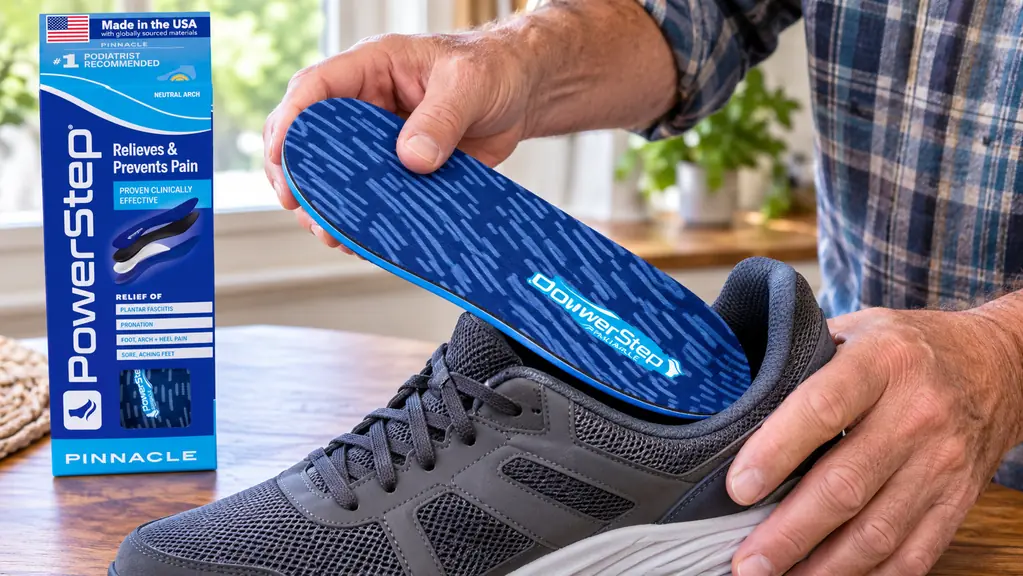
Third is what the listing tells you up front. PowerStep is the brand that shows up in podiatry offices, the Pinnacle is billed as the podiatrist recommended one, it is made in the USA, and it carries a 30-day money-back guarantee. I never once felt like I was guessing. It also fits a range of shoe types, from athletic shoes to everyday walking shoes, which matters if you rotate two pairs the way I do. You do have to order it, and you do have to read the size chart. The pair I checked was sized Men's 12-13, and the brand lists men's and women's sizing separately, so the number on the box is not always the number you expect.
Where Dr. Scholl's Wins
I am not going to pretend the drugstore insole is junk. Dr. Scholl's is on a shelf at every grocery store and pharmacy in Dayton, and if your shoes are killing you on a Tuesday evening, you can have relief before supper. There is real value in that. The PowerStep is an order and a wait and a size chart you have to think about. The Dr. Scholl's is a decision you can make in aisle nine with your car keys still in your hand, and that counts for more than people admit when their feet hurt right now.
The second genuine win is comfort out of the box. Dr. Scholl's is built to feel good the minute you drop it in. Soft under the whole foot, no break-in, no adjustment while your arch gets used to being held up. If you have never worn a structured insole before, the Pinnacle will feel odd for a day or two, almost like a lump under your midfoot, and then it stops feeling like anything at all. The Dr. Scholl's never asks you to push through that. For somebody who is already sore and tired and does not want one more thing to endure, that is a fair reason to choose it.
Third is what happens at the register. A drugstore insole is a fraction of the cost of a supportive one, and for plenty of people that settles the whole question. My honest answer is that you will likely go through two or three of them in the time one Pinnacle lasts, but you will not know that until you have done it, and nobody should have to take my word for the arithmetic. Cheap is not the same as wasteful, and expensive is not the same as smart. It depends how many miles you put on them and how much your arch complains at the end of the day.
The Pair I Keep Replacing With the Same Pair
Firmer arch support that holds through a full shift on concrete, dense heel cushioning, sized by shoe size, and a 30-day money-back guarantee if it does not suit your feet.
Amazon See Current Availability on Amazon →What the Difference Feels Like at Mile Three
Here is the part no packaging can tell you. Walk a flat loop around the neighborhood in a soft insole and it feels great. Walk four miles and reach the last stretch, the part where your arches and heels have a quiet conversation about whether to keep going, and the two insoles are not the same product anymore. The soft one has compressed under the heaviest part of your foot. The Pinnacle has not. The last Saturday in September, Curtis and I did the park trail, a little over five miles with two long hills in the middle of it. I had the Pinnacle in that day. About four miles in, the point where I normally start bargaining with myself, my feet were tired but nothing was stabbing. The following weekend I put a soft pair in the same shoes for the same trail and I was ready to quit at three and a half miles.
I felt the same split on days when a shift followed a walk. Standing still is harder on my feet than moving, and concrete is where cushioning gives out first. With the Pinnacle in my shoes I could get through a shift without that deep ache under the arch that tells me I have been foolish. With a soft drugstore pair I would feel it by mid afternoon and start shifting my weight from one foot to the other like a shopping cart with a bad wheel. By the time I clocked out I was walking on the outside edges of my feet without even deciding to.
None of this is a cure for anything. Insoles help comfort. They hold your foot up while you are on it and take some of the pounding off your heel and arch. If your pain is sharp, persistent, or getting worse instead of better, put the insoles down and go see a podiatrist. I say that as a woman who waited far too long the first time and paid for it in a waiting room with a magazine from 2019.
Soft feels good for a week. Dense is still doing its job at mile three, on concrete, in the last hour of a shift.

A Word on Sizing and Fit
Read the size chart. That is the single most common way people get this wrong. PowerStep lists men's and women's sizes separately, and the pair I looked at was their Men's 12-13, so you need to match the chart to your actual shoe size and not to the number you wear in a sneaker from a different brand. I made that mistake once with a different insole years ago and ended up trimming the edges with kitchen scissors, which is a good way to ruin both the insole and your afternoon. The listing also notes medium shoe width. I wear a wide shoe, so I paid attention to how the insole sat and whether it crowded my toes. It did not, but I would still check that chart twice before ordering.
The listing gives the arch type as neutral, which is worth knowing before you buy. If your arches are very high or very flat, that is a conversation to have with someone who can actually look at your feet, not a decision to make from a product page at midnight. I have slightly flat arches and the Pinnacle's support was comfortable for me, but feet vary enormously and the 30-day money-back guarantee exists for a reason. Use it if the fit is wrong. That is what it is there for.
How I Compared Them
Same shoes, same route, alternating weeks. I ran the back and forth over about two months last spring, mostly because that is when my walking is heaviest and my patience for discomfort is thinnest. Two weeks with the PowerStep Pinnacle in my walking shoes, then two weeks with a Dr. Scholl's pair in those same shoes, and I wrote down what I noticed at the start, the middle, and the end of each walk. I did the same loop before work and the park trail on days off so I had both kinds of walking in the mix. That is not lab science. It is what a person with a day job and a husband who walks on weekends actually does with two sets of insoles in the house.
What I watched for: whether the arch support stayed where it started, whether the heel cushioning bottomed out, whether the insole stayed put inside a wide shoe without sliding toward my toes, and how many weeks it went before it started to feel thin underfoot. I checked the position of each insole every time I took my shoes off, which sounds fussy written down but takes about four seconds. Nothing was measured with a tool. I just paid attention and wrote it down, the same way I track miles on a pair of shoes.
What I Liked
- Firmer arch support that holds its shape through a long shift
- Dense heel cushioning that does not flatten out after a month
- Fits a variety of shoe types, including everyday walking shoes
- Made in the USA and backed by a 30-day money-back guarantee
Where It Falls Short
- Takes a day or two to get used to the firmer arch
- Costs more upfront than a drugstore insole
- You have to order it and read the sizing chart carefully
- If you want a soft, plush feel underfoot, this is not that
Who Should Buy Which
Buy the PowerStep Pinnacle if you are on your feet for long stretches, if you walk several miles most days, if your arches run flat or tired by the afternoon, or if you have already worked your way through two or three soft insoles in a year. That is the pattern that pushed me to it. It suits someone who wants a firm, supportive feel and is willing to give it a day or two to settle in under the foot.
Buy the Dr. Scholl's if your shoes are simply uncomfortable and you want relief before the weekend, if you are not ready to spend much on an experiment, or if you have never worn a structured insole and want to find out whether support helps you at all before you commit to a firmer one. That is a sensible first step and I would not talk a coworker out of it on a break.
One practical note if you rotate shoes the way I do. Two pairs of walking shoes means two sets of insoles, and the cheaper one is easier to justify buying in multiples. That is a real argument and I will not pretend it is not. I just got tired of buying the same thing over and over and feeling my arch give out anyway.
Start With the Pair That Survives Week Six
PowerStep Pinnacle, the podiatrist recommended one, made in the USA, with a 30-day money-back guarantee. Read the size chart, then walk four miles and decide for yourself.
Amazon See Current Availability on Amazon →