

The first two miles were never the problem. It was mile three, the stretch of sidewalk past the old elementary school, where my heels would start talking to me. Not a sharp pain. More of a dull ache that made me shorten my stride without noticing I was doing it.
I walk four to five miles most days. A loop around the neighborhood before my shift at the hardware store, and a longer trail at the park on my days off. In between, I stand on concrete for eight hours. For a long time I figured sore feet were just part of that, something you accept at fifty-six, the same way you accept reading glasses and needing both hands to get up off the floor.
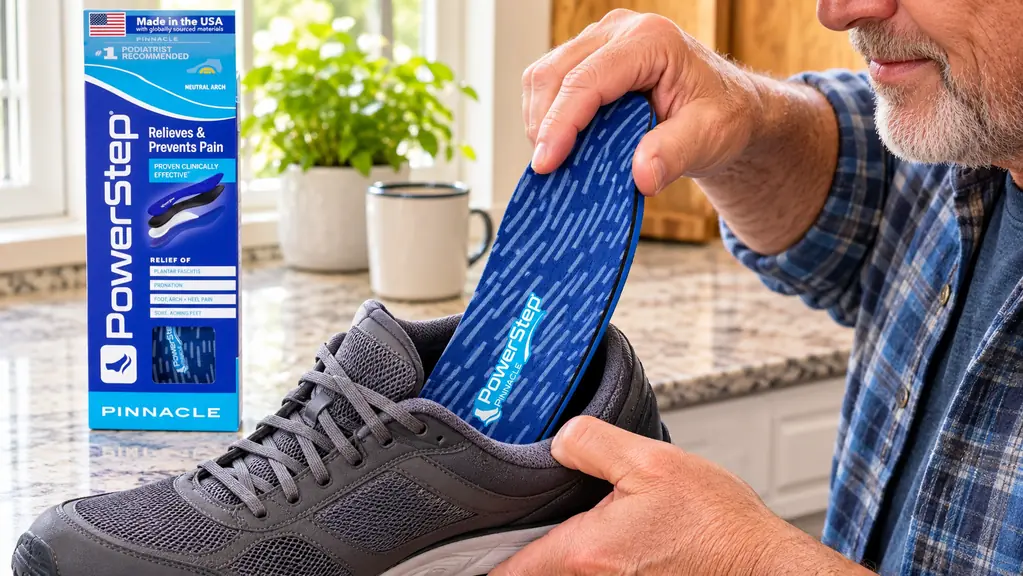
That is how I ended up trying PowerStep Pinnacle. A woman I work with has run the register at that store for nineteen years and never once sat down. She told me to stop buying the drugstore inserts that go flat in a month and get something with a real arch under it. The Pinnacle is what she wears. I ordered a pair that night, mostly because I was tired of complaining about my feet to a man who has heard it before.
Here is what you are actually buying, minus the label talk. The Pinnacle is an insole made of ethylene vinyl acetate, EVA for short, the same firm foam that shows up in the midsole of a decent walking shoe. It weighs 2.4 ounces. The listing describes it as maximum cushioning with arch support and a neutral arch profile, and calls it the top podiatrist recommended insole. It is made in the USA and backed by a 30-day money-back guarantee. They are not soft pillows. That matters, and I will come back to it.
The first walk I took with them was three miles and I noticed two things. The back of my foot stayed put instead of sliding forward, which meant I stopped gripping with my toes to keep the shoe on. And the arch sat under my foot instead of beside it. My arches run on the flat side, and most inserts feel like a speed bump parked somewhere near the middle of the foot, in the wrong spot. This one landed where the arch actually is.
I stopped gripping with my toes to keep the shoe on. That was the whole change, and it changed mile three.
The Pair That Made Mile Three the Easy Part
PowerStep Pinnacle is built around arch support and cushioning that holds its shape past the first month. If your feet quit on you at the end of a walk instead of the start, this is where to look.
Amazon Check Today's Price on Amazon →The firmness is the part you have to get used to. The first week, my arches felt worked, the way your legs feel after a hill you are not used to. That faded by day six or seven. If you want something you sink into, this is not that. It is support, and support has some backbone to it.
One practical thing: an insole takes up room in a shoe. In my regular walking pairs I had to loosen the laces a notch for the first few days, and in a pair I already wore snug, the insert made the toe box feel crowded. I move mine between my two main walking pairs, which takes about ten seconds in the morning. 2.4 ounces does not sound like it would matter, but an insole changes how a shoe fits more than it changes how it weighs.

I keep a notebook with the miles on each pair of shoes and I replace them somewhere between 400 and 500 miles. That habit came out of a rough stretch of heel pain a couple of years ago that got me serious about what I put on my feet. What I learned the hard way is that an insole cannot rescue a worn out shoe. A dead shoe with a good insert in it is still a dead shoe. When my trail pair hit 470 miles this spring, the PowerStep pair did not save them. New shoes did.
Curtis comes with me on the weekend trail walks, and he is the reason I noticed the difference at all. He talks the whole way and I usually go quiet around the turnaround, saving my breath and favoring the sore side. Somewhere in the second month he asked why I had stopped lagging on the way back. I had not thought about it until he said it out loud.
I want to be straight about what an insole does. It makes walking more comfortable. It does not fix a foot, and it is not a treatment for anything. Mine helped with the everyday ache of concrete floors and long miles. If your pain is sharp, or it is there when you get out of bed and does not ease up, or it is getting worse instead of better, that is a podiatrist conversation, not an insert.
What I'd Tell You If We Were Sitting at My Kitchen Table
I would tell you to buy them somewhere you can send them back, and then walk in them for a week before you decide anything. Thirty days is the window PowerStep gives you, and that is enough time to know. I would tell you not to judge them in the first hour, because they will feel like something under your arch and that is the entire point. I would tell you they are worth it if you are on your feet for a living or you walk most days and your feet are the thing that limits you. And I would tell you to skip them if your shoes are shot, because new shoes will do more for you than any insert, and fixing the shoe always comes first.
Then I would tell you the boring thing my coworker told me, which is that the insert only works if it is in a shoe you actually wear. Mine live in my walking pairs. They come out at night and sit on the shelf by the door so I do not forget them in the morning. That is the whole system. It is not complicated, and it has kept me walking four to five miles a day at fifty-six, which was the only result I was ever after.
Four Miles a Day Starts With What's Under Your Foot
PowerStep Pinnacle, with arch support, cushioning and a 30-day money-back guarantee. Move one pair between your walking shoes and stop dreading the back half of the loop.
Amazon Check Today's Price on Amazon →