
I bought the Copper Compression arch sleeve expecting it to be the fix, and that is the honest place to start this review. Two years ago I had a stretch of heel pain that scared me straight about shoes, and since then I have been willing to try almost anything that promises my feet will still feel decent at the end of a shift. I work part time at a hardware store in Dayton, Ohio, and I am on concrete for hours at a stretch. I also walk four to five miles most days, a loop around the neighborhood before work and a longer park trail on my days off.
So when a coworker mentioned she wore a little fabric band around her midfoot instead of pulling the insoles out of her shoes every morning, I ordered a pair of the Copper Compression sleeves that same week. What follows is what nobody told me before I clicked buy. Not the sales page version, and not the five-star version either. This is the version from someone who wanted the thing to work and then had to be honest with herself about where it did and where it did not.
The Quick Verdict
A genuinely useful little band for midday arch fatigue, not a replacement for the shoe and insole work that addresses the root of the problem.
Amazon Check Today's Price →Want to see what the arch sleeve costs today before you read the rest?
It is a small purchase compared to a new pair of shoes, which is exactly why I tried it. Current price and sizing details are on the listing.
Amazon Check Today's Price on Amazon →What This Sleeve Actually Is (And What I Got Wrong)
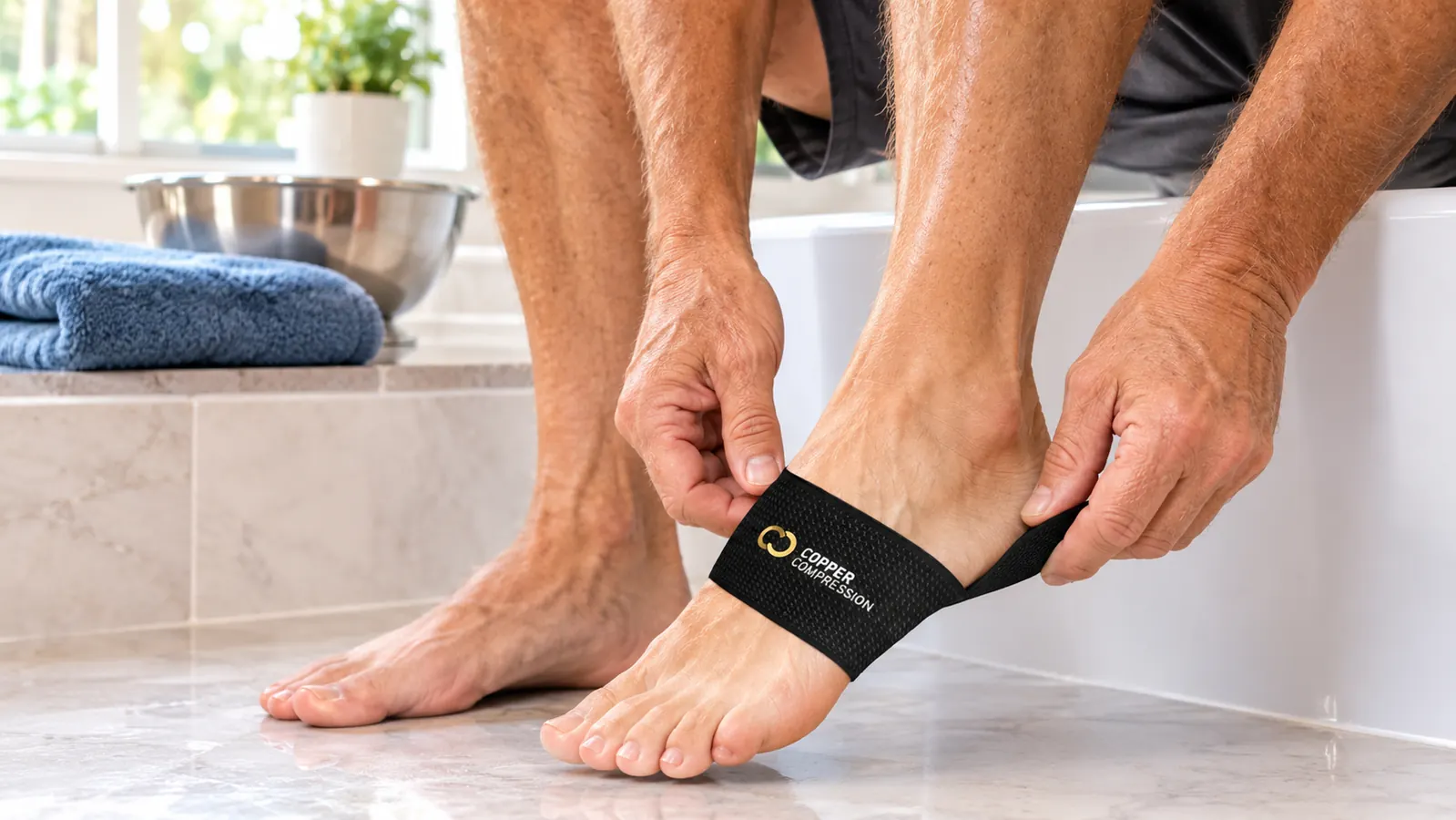
Here is the misconception I walked in with. I assumed an arch sleeve was an insole with a strap, something that would sit under my foot and hold my arch up the way my running shoe insert does. It is not that. The Copper Compression sleeve is a slim band of stretchy polyester blend that wraps around your midfoot, over your arch, and hugs it. The listing says it plainly, and I did not read it plainly: a sleeve, not an insole.
That distinction matters more than any other thing in this review. An insole takes up room in your shoe and changes how your foot sits inside it. This band does not. It goes on like a sock and adds barely any thickness, so it slides into sneakers, work shoes, boots and even sandals, and your shoe still fits the way it fit before. For someone like me, who had already spent money getting the right shoes and did not want to start that whole process over, that was the appeal.
One pair comes in the box. One size. The band measures about 6 by 4 by 0.5 inches folded and just over an ounce on a kitchen scale, so it is not much of a presence in a drawer or a work bag. The listing describes it as arch support for high arches and low arches both, with the point being gentle compression rather than a rigid lift. It is also quick to rinse and hang dry, which I will get to, because fabric worn against a foot all day has a maintenance reality the product page does not dwell on.
How I've Used It, Honestly
I started wearing the sleeves on work days first, because that is where my feet complain loudest. Concrete floors, eight hours, a lot of standing and a fair amount of walking out to the garden center and back. I put them on in the morning with my work shoes and took them off when I got home.
The first week, I noticed the compression more than any support. There is a snug feeling across the middle of the foot that takes a couple of days to stop noticing. By day three I had stopped thinking about it, which I count as a good sign. Something that announces itself all day long is a nuisance, not a tool.
By the second week I had worked out my honest pattern of use, and it is not the pattern the marketing suggests. I do not wear them for a full four-mile walk anymore. I wear them for the back half of a long workday, or I slip them on at lunch when my arches start to feel tired, and I wear them for the last three or four hours of my shift. That is where they earn their place in my routine, and that is the only claim I am making for them.
I keep a small notebook where I track miles per pair of shoes and replace them somewhere around the 400 to 500 mile mark. I added a line for the sleeves. In four months of regular use, the fabric has held its shape and the seams have not split. No pilling to speak of, and no stretching out to the point where the band goes slack and stops doing anything. That is a modest durability claim, but for a fabric band that gets washed every few days, it is the claim I can actually stand behind.
The Fit Is a Coin Flip, and Nobody Warns You
This is the thing I most wish someone had said out loud before I bought them.
The sleeve is one size. The listing says it works for high arches and low arches, and my arches are on the flatter side, so I am in the group it claims to cover. Even so, the fit took real fiddling. If it sits too far forward, it presses into the ball of my foot and I feel it with every single step. Too far back and it does nothing except feel like a sock that has bunched up under the arch. The sweet spot for me is just behind the ball of the foot, snug enough that I can feel it but not so snug that it leaves a deep mark when I take it off. It took me a solid week of adjusting it two or three times a day to find that spot consistently.
I want to be fair here. When it is sitting right, the difference shows up within a few minutes, particularly on concrete. My arches feel less like they are doing all the work themselves. But that adjustment period is real, and if you are the kind of person who tries a thing once, finds it uncomfortable, and tosses it in a drawer, this product will end up in the drawer.
The sweet spot for me is just behind the ball of the foot. It took a solid week of adjusting it two or three times a day to find that spot consistently.
Where It Comes Up Short
An honest review has to include the parts that did not work, and there are three.
The first is sweat. A band of polyester blend wrapped around the midfoot, worn for eight hours on a July shift, gets damp. Not a crisis, but it means the sleeves go in the wash every couple of days, and you need to think about that before you buy one pair. If I were doing this again, I would buy two so one is always dry and ready to go.
The second is that the sleeve does not stay put in every shoe. In my walking sneakers it behaves well. In a looser pair of slip-on work shoes, it shifted enough during a long shift that I had to reach down and reset it in the middle of the aisle. The listing says it works in almost any shoe, and I believe that is true in the sense that it fits. Whether it stays where you put it depends on how much room the shoe gives it.
The third is the big one, and it is the reason I did not score this higher. This is a comfort product. It is not a fix. My arches felt better while wearing it. My shoes did not suddenly fit differently, my heel did not stop being sensitive after a long day, and nothing about the underlying reason my feet complain changed. The band helps you get through the day. It does not undo the day.
That is not a knock on Copper Compression specifically. It is what a fabric arch sleeve is, and expecting more from it is how people end up disappointed. The reviews that read like a cure are doing a disservice to the product and to the person buying it. If your foot pain is persistent, comes back after rest, or wakes you up at night, that is a conversation with a podiatrist, not a purchase.
The Honest Pros and Cons
Here is the whole thing in one place, without the sales language on either side.
What I Liked
- Slides into sneakers, work shoes, boots and sandals without changing how the shoe fits, because it adds almost no thickness under the foot
- Noticeable relief for tired arches within a few minutes once it is positioned right, especially on concrete floors
- Holds its shape after four months of near-daily wear and repeated hand washing, with no fraying and no slackening
- Small and light enough to live in a work bag or a jacket pocket, so it travels to whatever shoes you happen to be wearing
- A low-cost way to find out whether midfoot compression helps you at all before spending on orthotics
Where It Falls Short
- One size only, and it takes a week or more of adjusting to find the spot where it stops pressing on the ball of your foot
- Polyester against the foot all day gets damp on warm shifts, so one pair means a wash cycle you have to plan around
- It shifts inside looser shoes, so it is not dependable in every pair you own
- No structural correction at all. It eases comfort while worn and does nothing about the reason your arches hurt
- There is no adjustment beyond position. If snugness across the top of the foot bothers you, there is no way to loosen it
Read that list and notice something. The pros are all about the day you are having right now. The cons are about what the product is not. That split is the entire story of this sleeve, and if the pros describe your situation, it is worth the small spend. If you were hoping a con on that list would turn out to be a misunderstanding, it is not.
One pair, one size, and a week of fiddling to find your fit
If you are going to try it, know that going in. Two pairs is better than one if you plan to wear them on sweaty shifts.
Amazon See the Current Price and Details on Amazon →
How It Compares to What I Was Already Doing
Before the sleeves, my system was simple. Good walking shoes, a supportive insert, and a pair of recovery shoes I wore around the house in the evening. That system worked, and I want to be clear that the sleeves did not replace any part of it.
An insert sits under the foot and takes up volume inside the shoe. It does more structural work than the band does, and I would not want anyone reading this to think otherwise. What the band does that an insert cannot is travel. I can wear it in a pair of sandals in the summer. I can put it on at lunch without taking my shoes off twice or pulling an insert in and out. I can toss it in my bag for a weekend walk with my husband Curtis and use it in whatever shoes I happened to bring.
So the fair comparison is not sleeve versus insert. It is sleeve versus nothing, on the days when your shoes are already sorted and your arches just need a little help getting to five o'clock. On that comparison, the band is worth having in the drawer.
I have also noticed it is a popular item with people who stand for a living. Nurses, teachers, retail and warehouse folks, anyone who spends the day on a hard floor. That tracks with my experience, and it is the use case I would point a friend toward first.
What Four Months of Wear Has Done to the Fabric
The Copper Compression sleeve is a polyester blend, which is what you want for something that needs to stretch, hug, and then recover its shape overnight. It does not feel cheap in the hand. It also does not feel like anything special, and I mean that as a compliment. It is a plain, functional band that does one job.
The maintenance is the part to plan for. A rinse and air dry is fine for a couple of wears, but after a full week of work shifts you are going to want to wash them properly. Because they are small, this is easy. Because you only get one pair, it means a day without them unless you plan around it. I hand wash mine in the sink with a little detergent and hang them over the shower rod, and they are dry by morning.
Four months in, mine still look like they did in week two. No frayed edges, and no thinning at the pressure points where the band crosses the arch. Fabric that thin, washed that often, is usually where you see the first failure, and I have not seen it yet. If that changes I will come back and say so.
Who This Is For
This is for the person who is already wearing decent shoes and still finds their arches tired by mid-afternoon. It is for anyone on a hard floor all day who wants a small piece of help they can put on and take off without rearranging their footwear. It is for someone who wants something that fits inside the shoes they already own and already like, rather than something that sends them shopping again.
It is also a reasonable first step for someone who is not ready to spend on orthotics or custom inserts and wants to find out whether compression across the midfoot makes any difference for them at all. As a low-cost experiment, it makes sense.
Who Should Skip It
Skip it if you are looking for structural correction. If your arches need to be held up, an insert does that and this does not. Skip it if you have one pair of shoes with almost no room in them, because a snug shoe plus a band is a bad combination. Skip it if you are sensitive about things feeling tight across the top of your foot, because there is no adjustment beyond sliding it forward or back.
And skip it if you are hoping it will solve persistent pain. It will not, and no fabric band will. If your foot hurts every day, gets worse as the week goes on, or has you limping for the first few steps in the morning, see a podiatrist. I say that as someone who put that visit off for a year and wishes she had not.
What I would tell a coworker on break is this. It is a good little tool for the back half of a long shift, and it is not the answer to why your feet hurt. Buy two pairs, expect to fiddle with them for a week, and keep your shoes in rotation. That is the whole honest review, and it comes from someone who wanted the thing to work more than she wanted to be right about it.
If a tired arch at 3pm is your problem, start here
One pair, one size, and easy enough to rinse and hang dry that it can keep up with a work week. It is a small bet on a small fix.
Amazon Check Today's Price on Amazon →