
Your walking shoes came with an insole, and it is not doing you any favors. Pull one out and look at it. It is a flat slice of foam with no shape to it at all, and it does about as much for your arch as a folded paper towel. That free liner is why so many of us finish the day with sore feet and blame the shoe. I stand on concrete nine hours a shift at the hardware store and walk four to five miles most days, and I spent two years buying different shoes before I understood that the shoe was only half the story. The other half is the PowerStep Pinnacle, the insole I finally put inside the shoes I already owned.
Here is the thing I wish someone had told me sooner. A good shoe and a good insole work as a pair, and neither one covers for the other. A worn out liner inside a well built walking shoe still leaves your arch hanging, and a shaped insole jammed into a shoe that folds in the middle will still fight you every step. Get both right and the difference shows up in the last mile, not the first one. That is where I noticed it, anyway, on the stretch of my loop where I used to start negotiating with myself about cutting the walk short.
The layer your walking shoe forgot to include
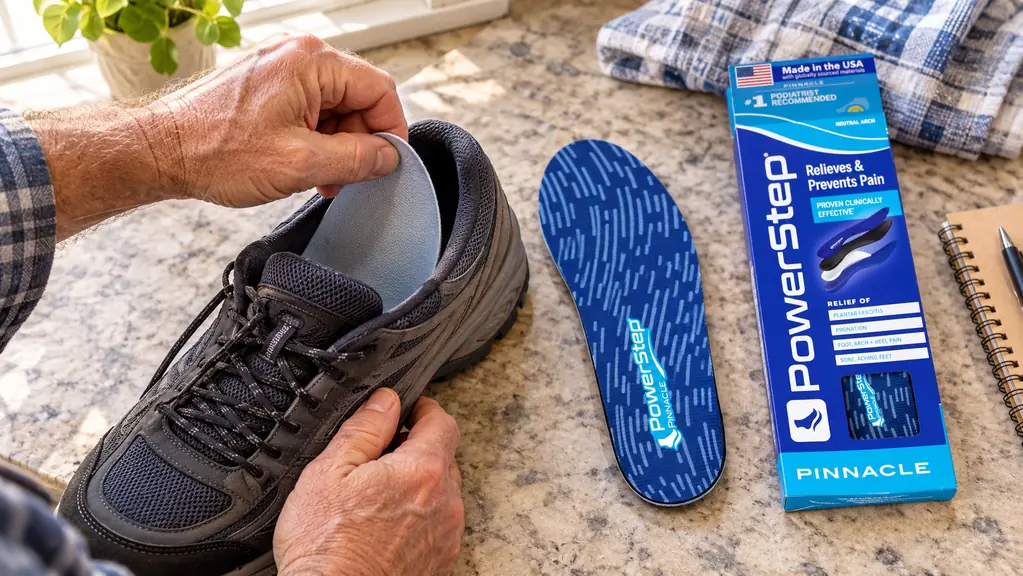
PowerStep Pinnacle puts a shaped arch and heel cushioning under your foot inside the shoes you already walk in. The listing carries a 30-day money-back guarantee, so a bad fit costs you a return rather than a new pair of shoes.
Amazon Check Today's Price on Amazon →What You'll Need Before Step One
Three things, and you probably own all of them. Your walking shoes, the ones you actually wear and not the pair sitting in the closet. The insoles. And the socks you walk in, because sock thickness changes how much room is left inside the shoe once something new is under your foot. I also keep a spiral notebook with the date I started a pair of shoes and the miles I put on them, and that notebook has saved me more grief than any single thing I have bought.
Step 1: Take the Factory Insole Out and Look at What Is Under It
Pull the liner out. Most walking shoes let you lift it with a thumbnail, and if it is glued down flat to the bottom, that tells you something about how the shoe was built right there. Set it in a drawer instead of the trash. If the new insole does not work out, the original goes back in and you are exactly where you started, no harm done.
Now look at the bed of the shoe. You want a flat, clean surface with no lumps and no old glue stuck to it. Wipe it out with a damp cloth and let it dry before anything goes in. A single grain of grit under an insole will find the arch of your foot by mile two, every single time, and you will spend the rest of the walk convinced the insole is the problem.
This is also the moment to be honest about the shoe itself. Press your thumb into the middle of the sole from underneath. If it folds in half like a taco, no insole is going to save that shoe for long walks. The PowerStep Pinnacle does its best work inside a shoe that already has some structure to it, and putting it in a soft shoe is like putting a good mattress on a broken frame. I learned that the expensive way. I had a lightweight pair I liked the look of, put an insole in them, and called the problem solved. Two weeks later the sole had a permanent crease across the ball of my foot and the insole was riding up at the heel every step. That pair went into the garden work pile.
Step 2: Get the Size Right Before You Commit
The listing sells these in men's and women's sizing, and the size chart on the page is worth two full minutes of your attention. Do not guess from your shoe size alone, especially if you are between sizes or you have a wide foot. I am an 8.5 wide and I read that chart twice before I ordered anything.
Set the insole in the shoe and look at how it sits before you put your foot anywhere near it. It should run from the back of the heel to the end of the toe box without curling up at either end. If it slides forward when you push your foot in, it is either too short for that shoe or the shoe is too roomy, and the fix is a different size, not more force.
One more note on width, because this one nearly cost me. The spec sheet lists a medium shoe width and my feet are not medium. The first two walks felt snug across the arch, snug enough that I had my hand on the drawer with the factory liners in it. By the end of the first week they had taken the shape of my foot and the snugness turned into the support I had been trying to buy in a shoe for two years. Give it a few walks before you decide.
Step 3: Set It In and Check the Room in the Shoe
An insole takes up room, and that room has to come from somewhere. Loosen the laces all the way down to the bottom eyelets before you slide your foot in the first time. Most people only loosen the top two and then wonder why the shoe suddenly feels a size short.
The PowerStep Pinnacle weighs 2.4 ounces, so weight is not what you notice. It is the volume. There is more under your arch than there was before and the upper of the shoe has to accommodate that. If the top of your foot feels pinched across the instep, pull the laces out of the top eyelet pair and re-lace skipping that set. Small change, real difference, and it costs you nothing. I did exactly that on a Tuesday evening before a shift, sitting at the kitchen table with the shoe in my lap, and the pinch across the top of my foot was gone before I got to the second eyelet. I had worried the laces would come up short with a set skipped. They did not.
Walk around the kitchen in them for a few minutes before you go anywhere. You should feel the arch make contact without a hard edge digging into the side of your foot, and you should feel the heel cushioning sitting under your heel bone. If something is poking you, take the insole out and check for a crease or a bit of grit underneath before you blame the insole itself.

Step 4: Break Them In on Short Walks, Not Your Long Loop
My instinct was to put them in on a Saturday morning and do the whole park trail with Curtis. That would have been a mistake. New support under a foot that has been walking flat for years needs a ramp, not a cliff. I did a mile a day for the first three days, then two miles, then my normal four to five. That first mile is shorter than it sounds, four blocks down to the corner and back, and on day one that was plenty. Day two I added the block past the school. By the end of that week I could feel my arch being held up on the last block instead of just the first one, which was the sign I had been waiting for.
Expect your calf to notice. When your arch is finally held up where it belongs, your lower leg works a little differently than it did in a flat shoe, and the first few walks will tell you so. That is not a problem. It is just new, and it settles down inside a week or so of regular walking.
Keep the factory liners in that drawer through this whole stretch. If the ramp goes badly, or if the size turns out wrong, you want the option to go back to what you had without hunting through the house for a piece of foam you threw away in March. That is the whole reason I stopped throwing the originals out years ago.
Same shoes. Same four mile loop. The only thing that changed was the layer under my foot.
Step 5: Track the Miles and Replace on Schedule
I write the date and the starting miles in a notebook whenever a new pair of shoes goes into service, and I do the same for insoles now. Shoes are finished somewhere around 400 to 500 miles for me, and the insole inside them is done sooner than the shoe is.
EVA foam, which is what these are made of, compresses. It does not tear and it does not look broken, it just slowly stops springing back. You notice it as the arch feeling flatter under your foot and the heel feeling thinner than you remember it. When that happens the shoe may still have a few hundred miles left in it, but the insole does not, and the two of them do not expire on the same day. My first pair went in on a Saturday in March and came out in June, right around 340 miles by the notebook, and the shoe they were in still had tread on it. I only knew to look because an ache behind the ball of my foot came back for a week and I could not work out why.
Check the shape against a new one if you are not sure. Set the old insole on the counter beside a fresh one and look at them from the side. The difference in arch height is usually plain once they are next to each other, and it explains a stretch of foot ache that seemed to come out of nowhere.
What Else Helps
Socks matter more than most of us admit. A thin cotton sock in a shoe that now has an insole in it leaves you fighting for room, and a seam across the toe will rub you raw by mile three. I switched to a cushioned walking sock with a flat toe seam and stopped thinking about my feet for whole walks at a time. The difference was clearest on a hot afternoon in July, when I wore the old thin pair out of the laundry basket rather than dig for the good ones, and I had a hot spot on my heel before I turned onto my street.
Rotating two pairs of walking shoes has done more for my comfort than any single purchase I have made. Shoes need a day to dry out and recover between walks, and alternating them means each pair lasts closer to its full mileage instead of both pairs dying in the same month. It also means a soaked pair on a rainy Tuesday does not end your walking week.
And if the ache does not settle after a few weeks of consistent support, go see a podiatrist. An insole helps with comfort, and comfort is worth having. It does not diagnose or treat a condition, and pain that sticks around deserves someone who can look at your foot in person. I say that as a woman who spent the better part of a year self-treating before she made the call. The listing describes these as plantar fasciitis relief, and I understand why people search that way, because I did. What an insole actually gave me was a supported arch under a foot that had been doing without one.
Start with the layer that sits closest to your arch
PowerStep Pinnacle is the insole I keep in my walking shoes, and the one I bought a second time so I would stop stealing the first pair. Take the size chart seriously, break them in slowly, and give them a few walks before you judge them.
Amazon Check Today's Price on Amazon →