
By the time I get back from my Saturday loop, my arches have an opinion. It starts as a dull ache under the middle of my foot, right where the arch comes down to meet the ground, and by the time I am climbing the porch steps it is a hot little spot that makes me walk on the outside of my heel. I walk 4 to 5 miles most days, and I spend my shifts at the hardware store standing on concrete, so my feet do not get many rest days. A couple of years ago a stretch of heel pain got me serious about shoes and insoles. What I did not have until recently was something to put on the foot itself, and that is the gap the Copper Compression Arch Support Sleeve fills for me.
Here is what I got wrong for a long time. I treated sore arches as a shoe problem and nothing else. Buy better shoes, swap the insoles, done. That helped, and I still do it, but it never touched the hour after a long walk, when the arch is tired and puffy and every step across the kitchen reminds you about it. So this is the routine I actually run now. Five steps, about fifteen minutes of work beyond the walking itself, and one slim sleeve you can wear in almost any shoe. Nothing here is medical treatment. It is comfort and recovery, and it is what keeps me walking 4 to 5 miles a day at 56 instead of backing off to two.
The Mile That Hurts Is Usually the One After You Stop
The Copper Compression sleeve is a slim band that wraps your midfoot and hugs the arch, under or over your sock, in sneakers, work shoes, boots or sandals. Your shoes stay exactly the same.
Amazon Check Today's Price on Amazon →Step 1: Check Your Shoes Before You Blame Your Arches
A tired arch is often a shoe that quit a hundred miles ago. I keep a log in a notebook now, the date I put a pair into service and the miles I put on it, and I retire them somewhere between 400 and 500 miles. Before the notebook I would walk in a pair until the tread looked bad, which is far too late. The part that matters is the midsole under the arch, and that goes soft long before the rubber on the bottom does. You will not see it in the tread. You will feel it in your arches about three miles in.
Here is the kitchen test. Take the shoe in both hands and try to fold it in half. If it rolls up like a newspaper, the foam is done and no sleeve is going to save that walk. Then look at the wear pattern on the bottom. Mine goes fast on the outside edge, which tells me I roll outward a touch, and being a wide fit means I need a toe box that does not squeeze my toes together. Fix the shoe question first. Step 2 only works if the shoe underneath it is still doing its job, and a sleeve worn inside a dead shoe is just a band holding a tired foot.
Step 2: Get the Sleeve Sitting Right on Your Midfoot
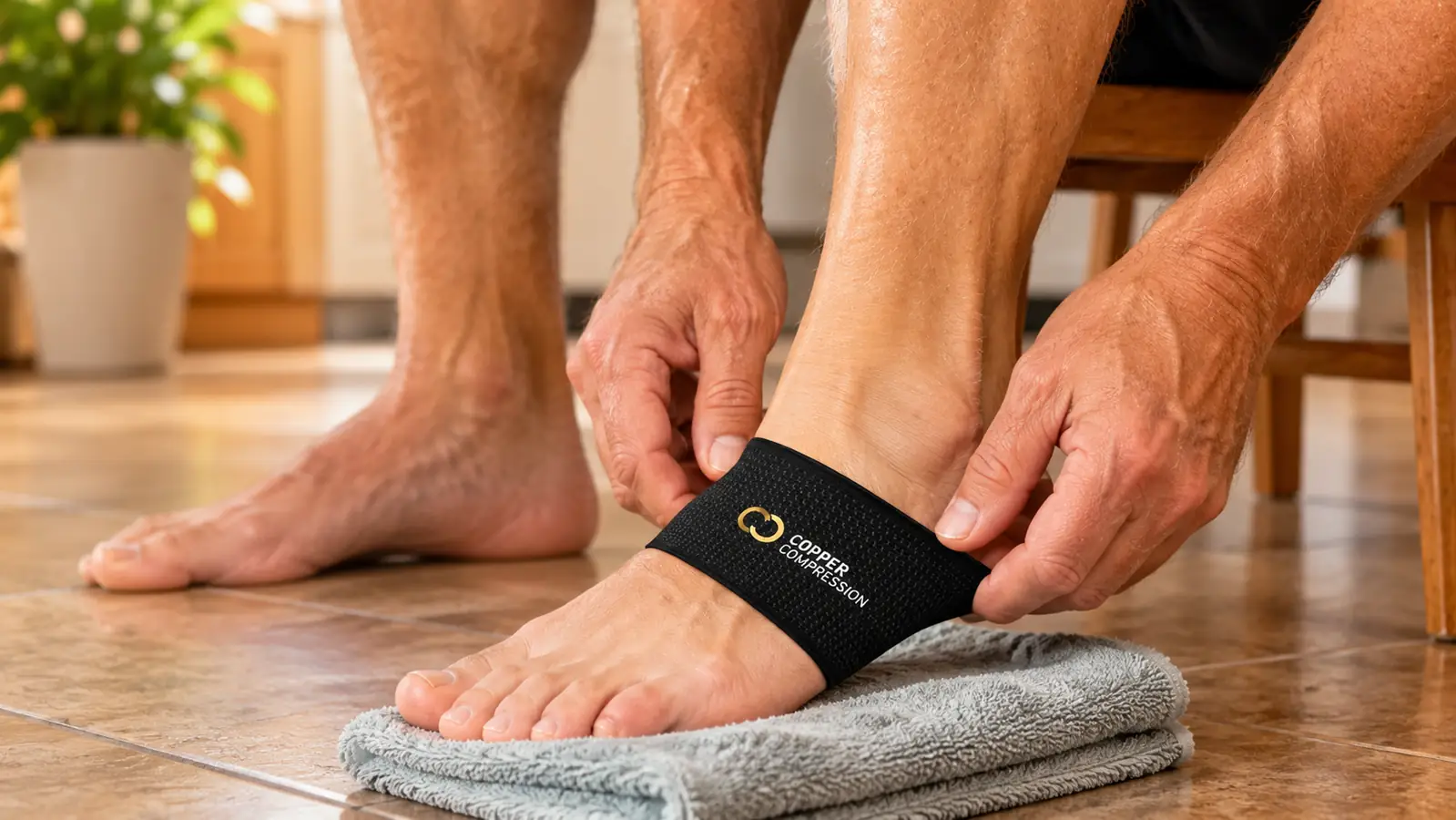
The Copper Compression sleeve is one size, sold as a pair, about 6 by 4 by 0.5 inches and 1.12 ounces each, a polyester blend that stretches. That is light enough that I forget I have it on by the end of the driveway. The important part is where it sits. It is a sleeve, not an insole, so it wraps around the midfoot and hugs the arch from underneath and around the sides. It should sit under the arch, not up at the ball of the foot, and not back on the heel like a cup. Slide it on, then run your thumbs around the edge to settle it.
I wear mine over a thin sock most days, but the listing says under or over socks and I have done both. Over a thicker wool sock it still goes on, it just takes a second pass to smooth the wrinkles out. Wrinkles are what you feel at mile three, so give it the extra ten seconds. The sleeve fits inside sneakers, work shoes, boots and sandals. At the store I wear it inside my work shoes on concrete days and it does not change how the shoe laces up or how much room my toes have, which matters when you are on your feet for eight hours. One note on fit: it is a compression band, so snug is the point, but it should never leave a deep groove in your skin. If it does, you have it rolled up too high or bunched under the arch.
Step 3: Wear It on the Walk, Then Leave It On for an Hour After
This was the change that mattered most for me. I used to take everything off the second I got in the door, and then spend the next hour hobbling around barefoot on a hard kitchen floor, which is the worst surface there is for a tired arch. Now the sleeve goes on before the walk and it stays on through the cool-down and the first hour at home. That is the window where my arches feel the most beat up, and the gentle compression is doing its job right then, not four hours later when I have already sat down.
I take it off before my shower and I do not sleep in it. On a day off with a longer park trail, same routine. Curtis and I do the trail together on weekends, and he will tell you I am not a person who fusses over herself, so the fact that I bother with this tells you something. One thing worth saying plainly, because I have read enough foot care pages that promise the moon: this is a comfort product. It supports. It compresses. It does not cure plantar fasciitis or anything else, and it is not a substitute for a shoe that fits or a calf that needs stretching.
Step 4: Cool the Arch Down While the Sleeve Is Still On
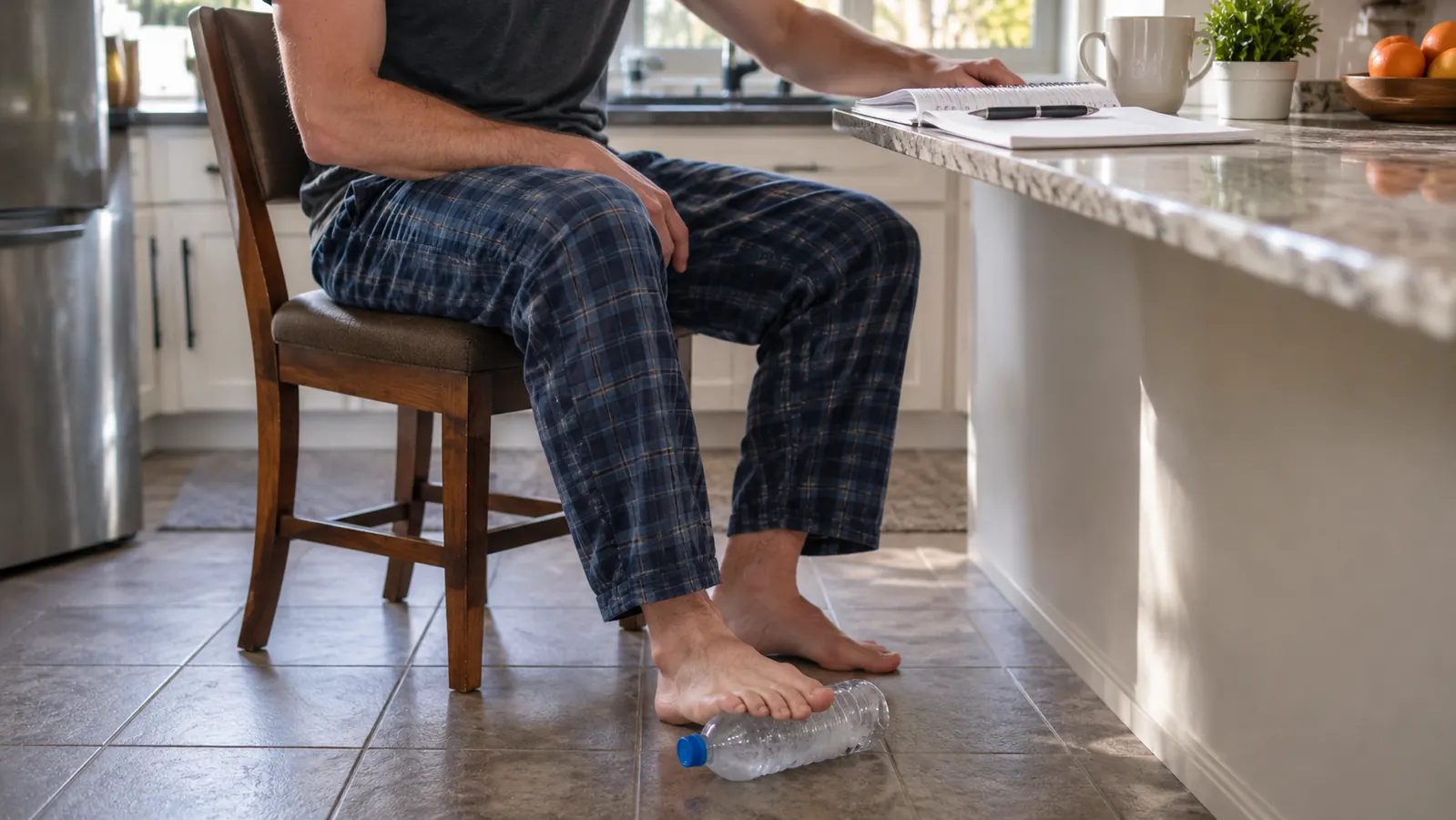
I keep a water bottle in the freezer door and roll my foot over it for about five minutes a side on the kitchen floor while the coffee brews. Then a calf stretch with my hands flat on the wall, thirty seconds a leg, three times through. Then five minutes with my feet up on a kitchen chair. If I skip the calf stretch I feel it the next morning, because a tight calf pulls on everything below it and the arch ends up doing work it was never meant to do.
The sleeve does not replace any of that. It is not a roller and it is not a stretch. What it does is make the twenty minutes between walking in the door and finally sitting down tolerable, so I actually do the rolling and the stretching instead of limping straight to the couch with my shoes still on. That is the whole trick, and it took me two years of sore evenings to figure it out. The recovery work is the work. The sleeve is what makes the work possible on a day when your feet are yelling at you.
The sleeve does not fix a worn-out shoe and it does not stretch a tight calf. What it does is make the hour after the walk tolerable enough that I actually do the stretching instead of limping to the couch.
Step 5: Log Two Weeks and Decide With Notes, Not Feelings
In my notebook I write three things after a walk: the miles, whether the arch ache had faded by bedtime, and whether I wanted the sleeve the next morning. Two weeks of that tells you more than any single good day or bad day, because feet are slow and a bad Tuesday can talk you out of something that was working. When I started this routine the ache was still there at bedtime maybe four nights out of seven. After two weeks it was one or two, and the difference was mostly the shoe replacement plus that after-walk hour.
There is also a line where you stop reading articles and go see somebody. If the pain is sharp rather than achy, if it is worse every week instead of better, if it wakes you up at night, or if it sits in one foot only and nothing you try touches it, call a podiatrist. I say that as a woman who put off a heel pain appointment for months and wished she had not. Foot care products help you stay comfortable while you walk. Figuring out what is actually wrong is a different job, and it is not mine or yours.
What Else Helps
Rotate two pairs of walking shoes instead of wearing the same pair every single day. The foam gets a full day to come back, and my pairs last closer to the 500 mile end of the range when I do it. I also pay attention to the surface. My neighborhood loop is asphalt and the park trail is packed limestone, and the limestone day is the one where my arches speak up, so I do not schedule two trail days back to back anymore.
At work, a rubber standing mat at the register made more difference than I expected, and I keep a second pair of work shoes in the car so I am not standing in the same pair for a ten hour shift. Socks matter too. Thin cotton is worse than a sock with some cushion under the arch, and damp socks on a summer walk are worse than either. If you carry a bag, lighten it. Five pounds on your shoulder shows up in your feet by mile four.
If you want to compare approaches before you buy anything, insoles are the other road, and the honest answer is that they do different jobs. Insoles change the shoe. A sleeve changes what is against your foot, which means it can move from one pair to another. I wrote up that comparison, plus a longer piece on what months of daily wear actually looks like, and a shorter list of the reasons arch sleeves suit sore feet in the first place. Ten minutes of reading will save you from buying the wrong thing twice.
Start With the Walk You Already Take
The Copper Compression sleeve comes as one pair in one size, under or over your sock, in the shoes you already own. Give it two weeks alongside the shoe check and the calf stretch before you make up your mind.
Amazon Check Today's Price on Amazon →