
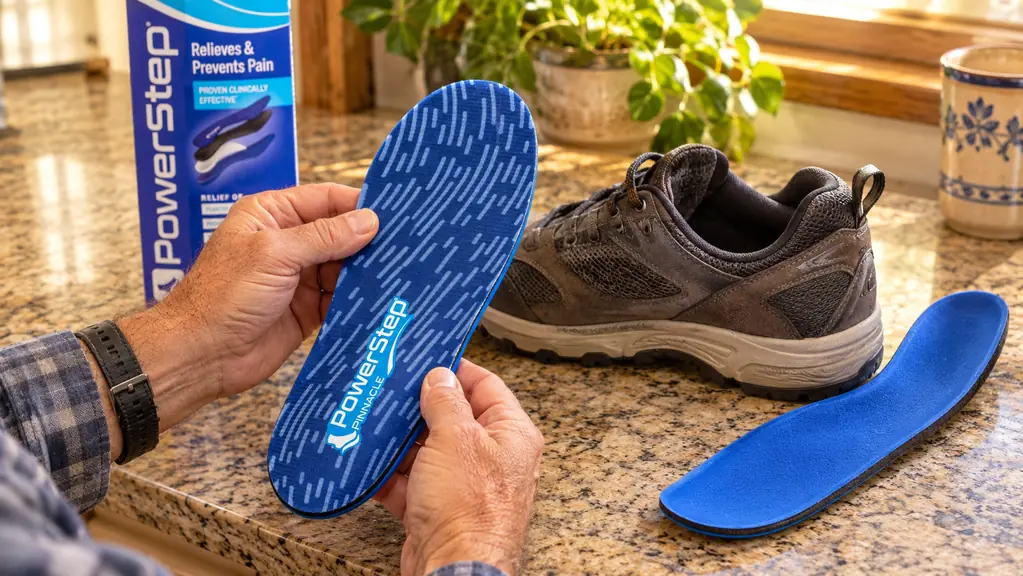
The first thing I want to get out of the way about the PowerStep Pinnacle is this: it is not soft. If you are picturing a gel pad you sink into, that is not what arrives in the box. It is a firm arch support with cushioning built on top of it, and the firmness is the entire point. I lead with that because nearly every complaint I have read about this insole comes from somebody who wanted a pillow and got a support instead.
I'm Denise Beauford. I'm 56, I work part time at a hardware store in Dayton, Ohio, and I stand on concrete six hours at a stretch. I walk 4 to 5 miles most days, a loop around my neighborhood before my shift and a longer park trail on my days off. My feet are a women's 8.5 wide with arches on the flat side, and a rough stretch of heel pain a couple of years back is what got me paying attention to what goes inside my shoes. This is my honest read on the PowerStep Pinnacle after wearing it, pulling it out, putting it back in, and comparing it against the flat factory liners I used to ignore.
The Quick Verdict
A firm, well-made arch support that does its best work in shoes with a removable liner. Buy it for support, not for pillow softness, and check the sizing conversion before you order.
Amazon Check Today's Price →If your heels are the part that hurts by two in the afternoon, start here
PowerStep Pinnacle pairs a firm arch support with heel cushioning, weighs 2.4 ounces a pair, and is sold in men's sizing. Made in the USA and covered by a 30-day money-back guarantee.
Amazon Check Today's Price on Amazon →How I Ended Up in a Pair of PowerStep Pinnacle Insoles
I did not go looking for an insole. I went looking for a shoe, and what I found was that about half the walking shoes in my size come with a liner you can pull out, and the ones that don't are the ones you are stuck with. A clerk at the running store downtown told me the thing every person who stands for a living eventually hears: the liner in the box is there to fill the space, not to hold up your foot. So I started swapping liners out.
The shoe I was replacing had somewhere near 480 miles on it, which is right at the edge of where I retire a pair. I had been walking in it anyway because it still felt fine in the store, and that is a trap. What I noticed first was not pain in the shoe, it was that the shoe felt level in a way it hadn't before, like the sole had quietly settled. The clerk pulled the liner out, set it on the counter, and pressed his thumb into the middle of it. It flattened and stayed flattened. That was the whole demonstration.
The first pair I tried was a gel insert that felt wonderful for about ten days and then flattened out to nothing. The second was so hard it felt like standing on a ruler. The PowerStep Pinnacle was the third, and it is the one that stayed in my shoes. It sits in the middle. Firm enough under the arch that you can feel it doing work, with enough cushioning under the heel that the ground stops announcing itself with every step.
What Nobody Tells You: These Are Firm, on Purpose
Every description of this insole says arch support, and arch support sounds gentle. It isn't, at first. The arch section is firm, and for the first two or three days your foot notices it constantly, the way your tongue notices a new filling in a tooth. That is the correction doing its job. If you have been walking on a flat liner for years, your foot has been doing work it was not built to do, and handing that work back takes an adjustment period no product can skip.
Here is the part I wish somebody had explained to me before my first pair of anything supportive. The discomfort of the first week is not the same thing as the pain you are trying to fix. My old pain was sharp, it lived in my heel, and it hit hardest on the first twenty steps out of bed in the morning. The new feeling was a dull pressure under the middle of my foot, and it faded over about a week. If it had been sharp, or one-sided, or getting worse instead of better, I would have stopped and made an appointment. It wasn't, so I kept going.
By the end of that first week I stopped noticing the arch at all. Now the only time I think about it is when I put on a pair of shoes without it, and the floor comes up to meet me flatter than it should.
The Sizing Is the Part People Get Wrong
PowerStep lists the Pinnacle in men's sizes. I wear a women's 8.5, so I went with the men's size that lines up with it, and the pair shown in this listing is a men's 12 to 13, which is one of the larger sizes they make. If you are a woman ordering for yourself, drop about two sizes from your women's number and go from there. I have watched more than one person order her own women's number and end up with something she could not use, and it has nothing to do with the insole and everything to do with the chart.
The other sizing note is width. I am a wide, and this insole is a medium width. That has worked fine in my walking shoes, but I want to be straight with you about it. In a wide shoe the insole does not fill the whole bed, and if your shoe is roomy across the ball of the foot you may feel the edge of the insole under the outside of your foot. My fix was to lace a little tighter across the middle. Somebody with a very wide foot and a very roomy shoe might not have that option.
Curtis wears a bigger shoe than I do, and the only reason his search was simpler is that his number was the one printed on the page. My advice is to pull the liner out of the shoe you plan to wear it in and compare that to the size chart before you order, not after. My other advice is to check the listing, because the size shown in the photo here is a men's 12 to 13 and you need to make sure you are picking the one that matches your foot.
My old pain was sharp and it lived in my heel. The new feeling was dull pressure under the middle of my foot, and it faded in a week. Knowing the difference is the whole game.
How They Feel on Concrete All Day
My shift is six hours on a sealed concrete floor, and that floor is the real test. The first thing that changed was the two o'clock hour. Before, that was when my heels would start talking to me and I would shift from foot to foot behind the register without even noticing I was doing it. With the PowerStep Pinnacle in my work shoes, two o'clock came and went, and I noticed around four that I had not thought about my feet once all afternoon.
I remember the Thursday it clicked, because Thursday is truck day, and truck day means I am not just standing, I am walking the length of the back room and back with boxes for most of the morning. My old routine on a truck day was to sit in the break room at the end of the shift and take my shoes off before I drove home. That Thursday I got to the car, sat down out of habit, and then realized there was no reason to. My feet were tired in the ordinary way you get tired after walking, not in the way that made me want to take my shoes off in a parking lot.
The second thing that changed was the morning. I want to be careful here because an insole is not a treatment and I am not a doctor. What I can tell you is that my mornings got easier once I stopped padding around the house barefoot and started putting support under my foot, in my shoes at work and in a pair of house slippers at home. The PowerStep Pinnacle was one part of that, along with better shoes and a lot less standing still. When the pain was at its worst, I saw a podiatrist, and if yours is persistent I would start there rather than in a shoe aisle.
The pair weighs 2.4 ounces. That is nothing. I have worn inserts that turned a walking shoe into a ski boot, and these don't do that. By the second mile I forget they are in there, and that is the highest compliment I can pay a piece of footwear.
What They Won't Do
They will not fix a worn-out shoe, and this is the point I want to be loudest about. If your walking shoes have 500 miles on them, the midsole is compressed and the shoe is finished. Putting a good insole into a dead shoe is like putting a new tire on a bent rim. I keep a notebook with my miles per pair and I replace shoes between 400 and 500 miles. The Pinnacle only ever goes into a shoe that still has some life in it, and that is the only way the difference shows up.
I made that mistake once already. I had a walking shoe I liked, the cushioning had gone soft in the heel, and instead of replacing the shoe I bought an insert and expected it to cover for months of wear. It did not, and I spent three weeks thinking the insert was bad when the shoe was the problem. The lesson cost me one pair of insoles and a good deal of unnecessary complaining to Curtis on our weekend walks.
They will not make a narrow shoe fit. They will not turn a dress shoe into a walking shoe. They will not stand in for a foot doctor if your pain is sharp, one-sided, or getting worse instead of better. Mine responded to support and to better shoes. Yours may need something different, and a podiatrist is the person who can tell you which.
And they will not feel like a cloud. If what you are after is the sensation of walking on foam, this is the wrong product, and I would rather say so now than have you find out a week after it arrives.

How They Hold Up
I put them in the work shoes in early March, when the ground was still frozen and my heels were complaining the loudest, and they stayed in that pair until the shoes themselves were done. That was roughly four months of six-hour shifts, five days a week, plus my own walking on top of it. When I pulled them out to move them into the new pair, I held them up to the window and looked down the length of the arch. It had the same curve it started with. The top fabric under the heel showed a little compression where my heel sat, and that was all.
That matters more than it sounds like it should. The gel pair I tried died quietly at about ten days and I only noticed because my heels started complaining again. These have kept their shape, and the cushioning under the heel has stayed where it started. The listing calls them durable and I would agree with that word, which is not a word I hand out often.
The construction reads as solid: EVA, made in the USA, one piece rather than layers glued together. There is a 30-day money-back guarantee on them, which I think is the right way to sell something like this. Feet are not one-size-fits-all in any sense, and a month is enough time to know whether your foot is going to accept a firm arch support or fight it.
What I'd Tell a Coworker on Break
If somebody asked me between shifts whether the PowerStep Pinnacle is worth trying, here is what I would say. If you stand on hard floors all day and your shoes have a liner you can pull out, yes, try it. Give it five days before you decide, because day one is not the day to judge it. Order the right size the first time. And understand that you are buying support, not comfort, and that the comfort is a side effect that shows up around day four and stays.
What I Liked
- Firm arch support that has kept its shape through months of daily wear on concrete
- Real heel cushioning where heel complaints actually sit
- 2.4 ounces a pair, light enough to forget by the second mile
- Made in the USA with a 30-day money-back guarantee, so you can test it in your own shoes
- Fits a range of shoe types, athletic shoes included, as long as the liner is removable
Where It Falls Short
- Firm, not soft, and that comes as a shock if you were expecting a pillow
- Men's sizing means women have to convert, and some people will get it wrong
- Medium width in a wide shoe leaves less room to spare than you might want
- Takes four or five days before it stops feeling like a foreign object
- Does nothing for a shoe that is already worn out, which is where a lot of buyers go wrong
Who This Is For
This is for the person who stands or walks on hard floors for a living and has been getting by on the liner that came in the box. It is for the walker with a neutral arch who wants support that lasts a full shift rather than a lap around the block. It is for anyone whose heels start complaining by mid afternoon and who has a shoe with a liner they can pull out. If that describes your week, the PowerStep Pinnacle is the most straightforward thing I have found to put under it, and the guarantee means you can find out in your own shoes instead of guessing in a store aisle.
Who Should Skip It
Skip it if your arches are high and rigid, because the listing puts this in the neutral arch category and a firm support under a stiff arch is an unhappy match. Skip it if all you want is a soft cushion under a tired foot. Skip it if you have a diagnosed foot condition and have not asked your podiatrist what to wear, because this is comfort, not care. And skip it if your shoes are on their last miles, because you will buy a fix you did not get and blame the insole for a shoe problem.
Pull the liner out of the shoe you walk in most, then put this in its place
The PowerStep Pinnacle is the pair that made my heels stop announcing themselves at two in the afternoon. Check the men's size conversion, give it five days, and use the 30-day guarantee if your feet disagree.
Amazon Check Today's Price on Amazon →